
For serious learners
JEE Main 2027 · Paper 1 · English medium
Ultimate 90 Days JEE Crash Course 2027
JEE Mains Intense Workshop 2027
Crack JEE Mains 2027 with confidence. Turn concepts into independent problem solving with a maximum of 10 students in your group.
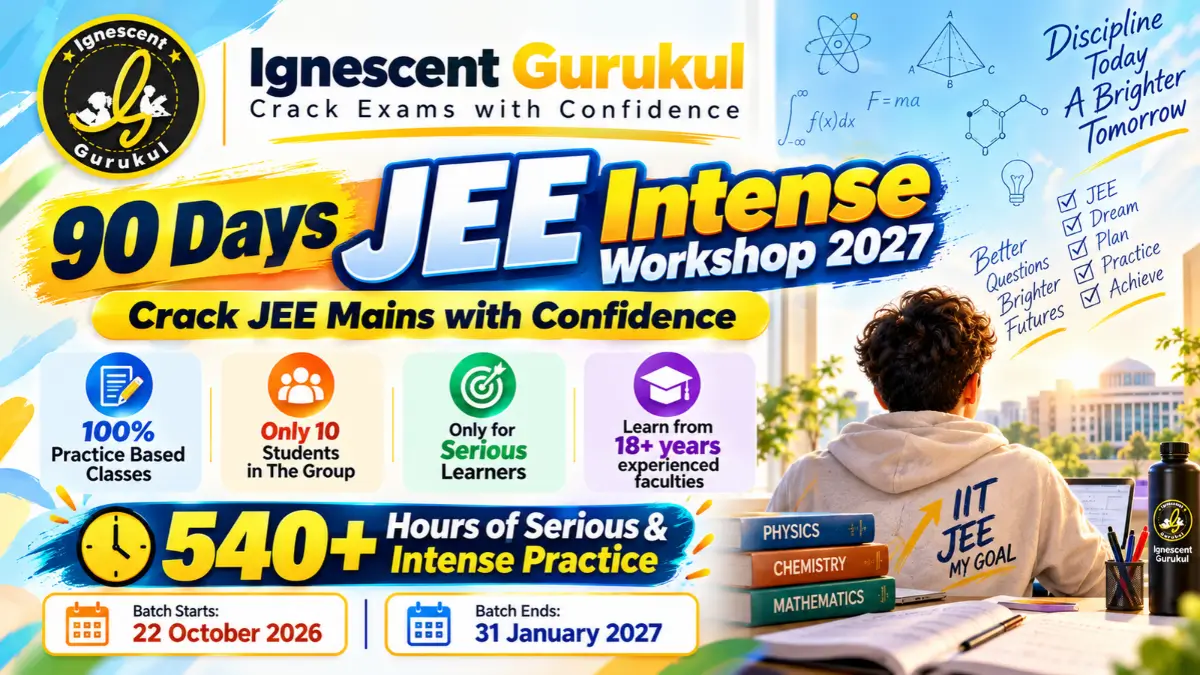
A clear plan. A serious commitment.
A JEE crash course 2027 built around your own attempts
The 90 Days JEE Crash Course 2027 at Ignescent Gurukul combines focused concept revision, guided question practice and regular assessment in Physics, Chemistry and Mathematics. It is designed for students who want structured JEE Main preparation with direct teacher attention and a demanding, consistent routine.
Choose the morning or evening batch. Attempt the daily paper, understand your mistakes and return to the next lesson with specific questions. The purpose is to improve accuracy, question selection and confidence through work you have genuinely completed yourself.
Students in each group
Classes, tests and guided discussions
Daily topic-wise Concept-Based Tests
Full Format Tests
Full Syllabus Tests
Experience across the faculty roster
The daily learning cycle
100% practice-based classes, with concepts put to work
Review the concept
Start each subject with a concise overview of the ideas, conditions and formulae needed for that day’s topic. Understand when a method applies before using it.
Solve 25–50 questions
Work through appropriately selected problems in each subject. Compare approaches, show your working and practise decisions about accuracy and time.
Attempt. Review. Repair.
Complete an online CBT of 75 questions: 25 Physics, 25 Chemistry and 25 Mathematics. Discuss results and doubts in the next day’s lesson, then revisit your errors.
What we practise
- Competency-focused and application-based questions.
- Relevant NCERT content and NCERT Exemplar problems.
- JEE previous-year questions across different shifts.
- Selected international Olympiad-level questions for deeper thinking.
- Faculty-developed questions and concept combinations for varied JEE Main difficulty levels.
Enrichment problems are selected for relevance. They do not represent a prediction of NTA’s 2027 paper or a change to the official syllabus.
A useful error notebook
For every wrong or skipped question, record the reason: concept gap, calculation slip, misread condition or time pressure. Re-attempt it without looking at the solution.
This makes your next revision specific. You spend time on what you actually need to fix, and teachers can see the reasoning behind your answers.
Explore our teaching approach and Concept-Based Tests.
Choose one batch
Morning and evening JEE Main workshop schedules
All timings are in Indian Standard Time (IST, UTC+5:30). Weekday subject start times are shown below. Brief transition breaks are included within the overall batch window.
Morning batch
Monday–Friday · 9:00 am–3:30 pm
- Physics begins at 9:00 am.
- Chemistry begins at 11:15 am.
- Mathematics begins at 1:30 pm.
Saturday: FFT, 9:00 am–12:00 noon.
Sunday: FST, 9:00 am–12:00 noon.
Both weekend tests are followed by results and doubt discussions.Evening batch
Monday–Friday · 5:30 pm–12:00 midnight
- Physics begins at 5:30 pm.
- Mathematics begins at 7:45 pm.
- Chemistry begins at 10:00 pm.
Saturday: FFT, 5:30 pm–8:30 pm.
Sunday: FST, 5:30 pm–8:30 pm.
Both weekend tests are followed by results and doubt discussions.22 October 2026 → 31 January 2027
Date-wise JEE crash course 2027 syllabus plan
This proposed teaching plan maps the supplied JEE Main 2026 Paper 1 syllabus to the 2027 workshop calendar. It covers all 20 Physics units, 20 Chemistry units and 14 Mathematics units, including experimental skills and practical chemistry.
22 Oct–27 Nov
Build the practice routine. Work through mechanics, thermal physics, foundational and Physical Chemistry, algebra, coordinate geometry and the opening calculus topics.
30 Nov–8 Jan
Complete electricity, magnetism, optics and modern physics; Inorganic and Organic Chemistry; calculus, vectors, 3D geometry, statistics and probability.
11–31 Jan
Revise mixed topics, repair individual weaknesses and practise timed sections. Continue weekend exam rehearsals, analysis and final doubt discussions.
Your daily Physics, Chemistry and Mathematics plan
Open a month to see every weekday. Each listed day includes the concept overview, guided practice and the daily online CBT; previous-day results are reviewed in the next lesson. The 72 planned CBT slots provide room for the stated 69+ target. Timetable refinements will be communicated by the institute.
October 20267 weekday sessions
| Date / daily CBT | Physics | Chemistry | Mathematics |
|---|---|---|---|
| Day 01 · CBT 01 | Units, dimensions and dimensional analysis | Mole concept, atomic masses and composition | Sets, relations and equivalence relations |
| Day 02 · CBT 02 | Errors, significant figures, vernier calipers and screw gauge | Stoichiometry, formulae and chemical equations | Functions: domain, range, composition and inverse |
| Day 03 · CBT 03 | Straight-line motion and graphs | Atomic structure: radiation, spectra and Bohr model | Trigonometric functions and identities |
| Day 04 · CBT 04 | Vectors in motion; relative velocity | Quantum numbers, orbitals and electronic configuration | Inverse trigonometric functions |
| Day 05 · CBT 05 | Projectile motion and circular kinematics | Periodic classification and periodic trends | Complex numbers, modulus, argument and Argand plane |
| Day 06 · CBT 06 | Newton’s laws, impulse and momentum | Ionic and covalent bonding; Lewis structures | Quadratic equations, roots and coefficients |
| Day 07 · CBT 07 | Friction, connected bodies and circular dynamics | VSEPR, hybridization, resonance and bond polarity | Complex-number and quadratic-equation PYQs |
November 202621 weekday sessions
| Date / daily CBT | Physics | Chemistry | Mathematics |
|---|---|---|---|
| Day 08 · CBT 08 | Work by constant and variable forces | Molecular orbitals, bond order and hydrogen bonding | Matrices and determinants |
| Day 09 · CBT 09 | Energy conservation, springs and power | Thermodynamics: heat, work and enthalpy | Adjoint, inverse and determinant applications |
| Day 10 · CBT 10 | Elastic and inelastic collisions | Hess’s law and enthalpy calculations | Consistency and simultaneous linear equations |
| Day 11 · CBT 11 | Centre of mass and rigid bodies | Entropy, Gibbs energy and spontaneity | Sequences: arithmetic and geometric progressions |
| Day 12 · CBT 12 | Torque, equilibrium and rotational equations | Redox reactions and balancing equations | Arithmetic/geometric means and sequence problems |
| Day 13 · CBT 13 | Moment of inertia and axis theorems | Chemical equilibrium: Kc, Kp and Gibbs energy | Counting principles and permutations |
| Day 14 · CBT 14 | Angular momentum and rotational energy | Equilibrium shifts, physical equilibria and Henry’s law | Combinations and applications |
| Day 15 · CBT 15 | Gravitation, potential and field | Ionic equilibrium: acids, bases and ionization | Binomial theorem: general and middle terms |
| Day 16 · CBT 16 | Satellites, escape speed and Kepler’s laws | pH, buffers and salt hydrolysis | Binomial-theorem problem practice |
| Day 17 · CBT 17 | Mechanics PYQs; principle-of-moments experiment | Solubility product and mixed equilibrium problems | Algebra mixed practice and error correction |
| Day 18 · CBT 18 | Elasticity, moduli and Young’s modulus experiment | Solutions and concentration units | Coordinate basics and straight-line equations |
| Day 19 · CBT 19 | Fluid pressure, flow and Bernoulli’s principle | Raoult’s law; ideal and non-ideal solutions | Lines: angles, distances and triangle centres |
| Day 20 · CBT 20 | Viscosity, surface tension and related experiments | Colligative properties and van’t Hoff factor | Circles, loci and line-circle intersections |
| Day 21 · CBT 21 | Thermal expansion, calorimetry and mixtures experiment | Conductance, conductivity and Kohlrausch’s law | Parabola in standard form |
| Day 22 · CBT 22 | Heat transfer: conduction, convection and radiation | Electrochemical cells and electrode potentials | Ellipse in standard form |
| Day 23 · CBT 23 | Thermodynamics: first law and processes | Nernst equation, Gibbs energy, batteries and fuel cells | Hyperbola in standard form |
| Day 24 · CBT 24 | Thermodynamics: second law and cyclic processes | Kinetics: rate law, order and molecularity | Coordinate-geometry and conics PYQs |
| Day 25 · CBT 25 | Kinetic theory, RMS speed and equipartition | Zero- and first-order reactions; half-life | Limits of algebraic and trigonometric functions |
| Day 26 · CBT 26 | SHM: equations, springs and energy | Arrhenius equation, activation energy and collision theory | Exponential/logarithmic limits and techniques |
| Day 27 · CBT 27 | Simple pendulum and experimental energy-loss graphs | Physical Chemistry PYQs and numerical review | Continuity and differentiability |
| Day 28 · CBT 28 | Travelling waves and superposition | p-block: groups 13–15, trends and first-element behaviour | Differentiation rules and elementary functions |
December 202623 weekday sessions
| Date / daily CBT | Physics | Chemistry | Mathematics |
|---|---|---|---|
| Day 29 · CBT 29 | Standing waves, beats and resonance-tube experiment | p-block: groups 16–18, trends and first-element behaviour | Composite, inverse and logarithmic differentiation |
| Day 30 · CBT 30 | Coulomb’s law and charge distributions | d-block: configurations and transition-element trends | Implicit differentiation and second derivatives |
| Day 31 · CBT 31 | Electric fields, dipoles and torque | Potassium dichromate and potassium permanganate | Rates of change and monotonicity |
| Day 32 · CBT 32 | Electric flux and Gauss’s law | f-block: lanthanoids, actinoids and contraction | Maxima and minima |
| Day 33 · CBT 33 | Electric potential and potential energy | Coordination: ligands, nomenclature and Werner’s theory | Indefinite integration: standard forms |
| Day 34 · CBT 34 | Capacitors, dielectrics and stored energy | Coordination compounds: isomerism | Integration by substitution |
| Day 35 · CBT 35 | Drift, resistance, resistivity and Ohm’s law | Coordination bonding, colour, magnetism and applications | Integration by parts |
| Day 36 · CBT 36 | Cells, circuits and Kirchhoff’s laws | Practical Chemistry: inorganic preparations and titrations | Integration by partial fractions |
| Day 37 · CBT 37 | Bridges, wire resistivity and electrical experiments | Qualitative salt analysis: specified cations and anions | Trigonometric integrals and mixed practice |
| Day 38 · CBT 38 | Biot–Savart and Ampere’s laws | Organic purification: crystallization, distillation and chromatography | Definite integrals and the fundamental theorem |
| Day 39 · CBT 39 | Magnetic force on charges and conductors | Organic characterization and quantitative calculations | Properties and evaluation of definite integrals |
| Day 40 · CBT 40 | Current loops, galvanometers and conversions | GOC: classification, nomenclature and structural isomerism | Areas bounded by curves |
| Day 41 · CBT 41 | Magnetic dipoles and magnetic materials | Stereoisomerism and molecular shapes | Differential equations: order, degree and separation |
| Day 42 · CBT 42 | Electromagnetic induction, Lenz’s law and inductance | Bond fission, reactive intermediates and their stability | Homogeneous and linear differential equations |
| Day 43 · CBT 43 | AC, LCR circuits, resonance and transformers | Inductive effect, resonance and hyperconjugation | Vectors, components and operations |
| Day 44 · CBT 44 | Electromagnetic waves and the spectrum | Organic reaction types and electron movement | Scalar products and vector products |
| Day 45 · CBT 45 | Reflection and spherical mirrors | Hydrocarbons: alkanes and conformations | 3D geometry: coordinates, directions and lines |
| Day 46 · CBT 46 | Refraction, thin lenses and lens combinations | Alkenes, alkynes and addition reactions | Angles, skew lines and shortest distance |
| Day 47 · CBT 47 | Prisms, total internal reflection and optical instruments | Aromaticity, benzene reactions and directive effects | Vector and 3D geometry mixed problems |
| Day 48 · CBT 48 | Wave optics: Huygens’ principle and interference | Organic halogen compounds: preparation and substitution | Statistics: mean, median, mode and mean deviation |
| Day 49 · CBT 49 | Diffraction, polarization and Brewster’s law | Halogen compounds: uses, reactions and environmental effects | Variance and standard deviation |
| Day 50 · CBT 50 | Photoelectric effect and de Broglie waves | Alcohols: preparation, reactions and identification | Probability: addition and multiplication theorems |
| Day 51 · CBT 51 | Atomic models and hydrogen spectrum | Phenols and ethers | Conditional probability and Bayes’ theorem |
January 202721 weekday sessions
| Date / daily CBT | Physics | Chemistry | Mathematics |
|---|---|---|---|
| Day 52 · CBT 52 | Nuclei, binding energy, fission and fusion | Aldehydes and ketones: carbonyl addition | Random variables and probability distributions |
| Day 53 · CBT 53 | Semiconductors, p–n junctions and rectifiers | Carbonyl reactions, named reactions and chemical tests | Algebra consolidation and PYQs |
| Day 54 · CBT 54 | LED, photodiode, solar cell and Zener diode | Carboxylic acids and acidity | Differential and integral calculus consolidation |
| Day 55 · CBT 55 | Logic gates and device identification | Amines and diazonium salts | Coordinate geometry, vectors and 3D consolidation |
| Day 56 · CBT 56 | Optical and electronic experimental-skills checklist | Biomolecules, vitamins, nucleic acids and hormones | Statistics and probability consolidation |
| Day 57 · CBT 57 | Full-syllabus consolidation and experimental PYQs | Practical Chemistry: organic tests, preparations and experiments | Full-syllabus mixed practice and error audit |
| Day 58 · CBT 58 | Kinematics, laws of motion and energy revision | Mole concept, thermodynamics, solutions and electrochemistry revision | Functions, trigonometry and algebra revision |
| Day 59 · CBT 59 | Rotation and gravitation mixed problems | Equilibrium and kinetics revision | Matrices, sequences, counting and binomial revision |
| Day 60 · CBT 60 | Thermal physics, thermodynamics and gases revision | Periodicity, bonding and p-block revision | Coordinate geometry and conics revision |
| Day 61 · CBT 61 | SHM and waves mixed problems | d/f-block, coordination and salt analysis revision | Limits, derivatives and applications revision |
| Day 62 · CBT 62 | Electrostatics and current electricity revision | GOC, isomerism and hydrocarbons revision | Integrals and differential equations revision |
| Day 63 · CBT 63 | Magnetism, EMI and AC revision | Organic conversions and functional-group revision | Vectors, 3D, statistics and probability revision |
| Day 64 · CBT 64 | Optics, modern physics and devices revision | NCERT-based biomolecules and inorganic review | Multi-chapter numerical problems |
| Day 65 · CBT 65 | Timed Physics section and error analysis | Complete practical-chemistry checklist | Timed Mathematics section and error analysis |
| Day 66 · CBT 66 | Experimental skills, units and graph-based questions | Timed Chemistry section and error analysis | Question selection and time management |
| Day 67 · CBT 67 | Multi-concept problems and numerical accuracy | Numericals, reaction discrimination and accuracy | Mixed PYQs and individual weak-topic repair |
| Day 68 · CBT 68 | Personal error-log repair: mechanics and thermal physics | Personal error-log repair: Physical Chemistry | Personal error-log repair: algebra and trigonometry |
| Day 69 · CBT 69 | Personal error-log repair: electricity and magnetism | Personal error-log repair: Inorganic Chemistry | Personal error-log repair: calculus |
| Day 70 · CBT 70 | Personal error-log repair: optics and modern physics | Personal error-log repair: Organic Chemistry | Personal error-log repair: geometry and probability |
| Day 71 · CBT 71 | Formula retrieval, experiments and timed selection | NCERT facts, practical chemistry and rapid recall | Formula retrieval and timed section practice |
| Day 72 · CBT 72 | Final consolidation and individual doubt resolution | Final consolidation and individual doubt resolution | Final consolidation and individual doubt resolution |
Saturday FFT + Sunday FST: all 15 weekends
FFT papers use the full exam format with announced taught or cumulative portions. FST papers cover the full syllabus from the first Sunday; early results provide a diagnostic baseline. Every test is followed by result analysis and doubts.
View the complete weekend test calendar24 October 2026–31 January 2027
| Week | Saturday · FFT | Sunday · FST | Review focus |
|---|---|---|---|
| 01 | 24 Oct 2026 · FFT 01 | 25 Oct 2026 · FST 01 | Baseline and taught-topic diagnostic |
| 02 | 31 Oct 2026 · FFT 02 | 01 Nov 2026 · FST 02 | Cumulative practice and weak-topic repair |
| 03 | 07 Nov 2026 · FFT 03 | 08 Nov 2026 · FST 03 | Cumulative practice and weak-topic repair |
| 04 | 14 Nov 2026 · FFT 04 | 15 Nov 2026 · FST 04 | Cumulative practice and weak-topic repair |
| 05 | 21 Nov 2026 · FFT 05 | 22 Nov 2026 · FST 05 | Cumulative practice and weak-topic repair |
| 06 | 28 Nov 2026 · FFT 06 | 29 Nov 2026 · FST 06 | Cumulative practice and weak-topic repair |
| 07 | 05 Dec 2026 · FFT 07 | 06 Dec 2026 · FST 07 | Cumulative practice and weak-topic repair |
| 08 | 12 Dec 2026 · FFT 08 | 13 Dec 2026 · FST 08 | Cumulative practice and weak-topic repair |
| 09 | 19 Dec 2026 · FFT 09 | 20 Dec 2026 · FST 09 | Cumulative practice and weak-topic repair |
| 10 | 26 Dec 2026 · FFT 10 | 27 Dec 2026 · FST 10 | Cumulative practice and weak-topic repair |
| 11 | 02 Jan 2027 · FFT 11 | 03 Jan 2027 · FST 11 | Cumulative practice and weak-topic repair |
| 12 | 09 Jan 2027 · FFT 12 | 10 Jan 2027 · FST 12 | Exam rehearsal and personalised error correction |
| 13 | 16 Jan 2027 · FFT 13 | 17 Jan 2027 · FST 13 | Exam rehearsal and personalised error correction |
| 14 | 23 Jan 2027 · FFT 14 | 24 Jan 2027 · FST 14 | Exam rehearsal and personalised error correction |
| 15 | 30 Jan 2027 · FFT 15 | 31 Jan 2027 · FST 15 | Exam rehearsal and personalised error correction |
Full Paper 1 syllabus coverage checklist
Unit names follow the supplied syllabus. Detailed subtopics are taught within these units and the daily topic groups above.
Physics · 20 units
- Units and Measurements
- Kinematics
- Laws of Motion
- Work, Energy and Power
- Rotational Motion
- Gravitation
- Properties of Solids and Liquids
- Thermodynamics
- Kinetic Theory of Gases
- Oscillations and Waves
- Electrostatics
- Current Electricity
- Magnetic Effects of Current and Magnetism
- Electromagnetic Induction and Alternating Currents
- Electromagnetic Waves
- Optics
- Dual Nature of Matter and Radiation
- Atoms and Nuclei
- Electronic Devices
- Experimental Skills
Chemistry · 20 units
- Some Basic Concepts in Chemistry
- Atomic Structure
- Chemical Bonding and Molecular Structure
- Chemical Thermodynamics
- Solutions
- Equilibrium
- Redox Reactions and Electrochemistry
- Chemical Kinetics
- Classification of Elements and Periodicity
- p-Block Elements
- d- and f-Block Elements
- Coordination Compounds
- Purification and Characterisation of Organic Compounds
- Some Basic Principles of Organic Chemistry
- Hydrocarbons
- Organic Compounds Containing Halogens
- Organic Compounds Containing Oxygen
- Organic Compounds Containing Nitrogen
- Biomolecules
- Principles Related to Practical Chemistry
Mathematics · 14 units
- Sets, Relations and Functions
- Complex Numbers and Quadratic Equations
- Matrices and Determinants
- Permutations and Combinations
- Binomial Theorem and Its Simple Applications
- Sequence and Series
- Limit, Continuity and Differentiability
- Integral Calculus
- Differential Equations
- Coordinate Geometry
- Three-Dimensional Geometry
- Vector Algebra
- Statistics and Probability
- Trigonometry
Your classroom. Your learning routine.
Online and offline JEE coaching with personal attention
Live online classes
Join face-to-face online sessions, participate in question solving and ask doubts in real time. Attempt online CBTs and use the next lesson to review errors with teachers.
- English-medium interaction in a group of up to 10.
- Workings, solutions and doubts discussed during class.
- Back-up lecture support through the institute’s learning arrangements.
- A suitable internet connection and a quiet study space are needed.
Offline classroom learning
Enquire about classroom study at Gariahat, Kolkata. Solve questions with the teacher present, show your written method and use feedback to correct weak steps.
- Maximum 10 students in the group.
- Practice sheets, written-work review and doubt discussions.
- Online CBT participation alongside classroom practice.
- Ask about current Kharghar, Navi Mumbai and hybrid batch availability.
Revision with feedback
Daily review and weekly test analysis connect revision to your actual mistakes. Topic order can be refined around the group’s learning needs.
More ways to practise
The institute also offers IGTS mock tests and customised test options. Confirm the available practice access for your batch.
Personal support
Ask admissions about progress reporting, back-up lectures and separate one-to-one tuition where additional individual support is needed.
Experienced subject guidance
Meet the JEE Physics, Chemistry and Mathematics faculty
Every faculty member listed has at least 8 years of teaching experience. Experience figures are supplied by the institute; batch-wise teacher allocation is confirmed at admission.
Physics
- Aakash Sir23 years
- Ramesh Sir26 years
- Avijit Sir9 years
Mathematics
- Adarsh Sir25 years
- Debagra Sir8 years
- Dharmendra Sir25 years
Chemistry
- Debapratim Sir8 years
- Indranil Sir12 years
- Anukul Sir30 years
Know your commitment
JEE crash course 2027 fees and payment options
One-time payment
₹51,000
Pay once at admission
For the complete Physics, Chemistry and Mathematics workshop.
₹3,000 lower than the two-instalment total.
Enquire about one-time paymentTwo instalments
₹54,000 total
₹27,000 + ₹27,000
First instalment: ₹27,000 during admission.
Second instalment: ₹27,000 by .
Obtain the final written payment schedule from admissions before paying.
Enquire about instalmentsEnrolment is subject to batch suitability and seat availability. Confirm the selected mode, centre, payment terms and any applicable charges directly with admissions. This enquiry page does not collect payment.
Questions before you join
JEE crash course 2027: frequently asked questions
What is the Ultimate 90 Days JEE Crash Course 2027?
It is Ignescent Gurukul’s JEE Mains Intense Workshop 2027 for Paper 1 (B.E./B.Tech.), combining Physics, Chemistry and Mathematics practice with daily Concept-Based Tests, Saturday Full Format Tests and Sunday Full Syllabus Tests. The group is capped at 10 students and the teaching medium is English.
When does the batch start and end?
The batch starts on 22 October 2026 and ends on 31 January 2027. “90 Days” is the programme title; the published dates span 102 calendar days, with 72 weekday dates and 15 weekends. The date-wise plan follows these actual dates. Any official exam-date clashes will be addressed in the batch timetable.
Is this a JEE Main crash course for Class 12 students and droppers?
Class 12 appearing students, droppers and repeaters can enquire. It is an intensive revision and practice programme, so students should be ready to review concepts quickly, attempt problems independently and attend the selected batch consistently. Admissions can help assess whether the timetable and current preparation level are a good fit.
What does 100% practice-based teaching mean?
Each subject begins with a concise concept overview, followed by 25–50 questions at an appropriate level. Students then receive a 75-question online Concept-Based Test covering taught topics: 25 questions each in Physics, Chemistry and Mathematics. Results and doubts are reviewed in the next day’s lesson.
What are CBT, FFT and FST?
CBT means Concept-Based Test: a topic-wise assessment delivered online. FFT means Full Format Test: a three-hour exam-format paper using the announced taught or cumulative portions. FST means Full Syllabus Test: a three-hour paper covering the complete Paper 1 syllabus. Early FSTs act as diagnostics, even while classroom revision is still in progress.
How many hours and tests are planned?
The programme targets 540+ hours across classes, scheduled tests and guided discussions, with 69+ daily topic-wise CBTs, 15+ FFTs and 15+ FSTs. The proposed calendar shows 72 weekday CBT slots and 15 scheduled FFT/FST pairs. A student chooses one batch; morning and evening hours are not added together.
What are the fees for the JEE crash course?
The one-time fee is ₹51,000. The instalment option is ₹27,000 at admission and ₹27,000 by 15 November 2027, totalling ₹54,000. One-time payment is ₹3,000 lower. Please obtain the final written payment schedule from admissions before payment.
Are online and offline JEE coaching options available?
Enquire about live, face-to-face online classes or offline learning at Gariahat, Kolkata. Online students participate in problem solving and doubt discussions, while offline students work with teachers in the classroom. The group limit is 10. Confirm current centre, hybrid and Kharghar, Navi Mumbai batch availability with admissions.
Is the JEE 2027 syllabus officially confirmed here?
The plan uses the supplied JEE Main 2026 Paper 1 syllabus as its working baseline for the 2027 target batch. It is not an official announcement that the 2027 syllabus or exam dates are unchanged. The final NTA JEE Main 2027 syllabus, bulletin and examination schedule take precedence.
Does the course include JEE Advanced or B.Arch/B.Planning preparation?
This page describes JEE Main Paper 1 preparation in Physics, Chemistry and Mathematics. Selected Olympiad-style questions are used for enrichment where relevant; they are not a separate official JEE syllabus. Dedicated JEE Advanced courses are linked below. Paper 2 aptitude, drawing and planning components are outside this workshop plan.
What is expected from a serious learner?
Attempt questions yourself before checking solutions, avoid copying answers, maintain an error notebook and revisit incorrect or skipped problems. Honest attempts let the teacher identify what needs attention. You do not need to know every answer already; you do need to participate sincerely.
How do I enrol or check seat availability?
Call or WhatsApp +91 83403 53648, or use the enquiry form. Share your current class, preferred batch and learning mode. Admissions will confirm suitability, availability and payment instructions. Submitting an enquiry does not reserve a seat or complete payment.
Take the next step
Enrol in the JEE Mains Intense Workshop 2027
Tell us about your preparation and preferred batch. Our admissions team will confirm course fit, availability and the next steps.
Find the right programme
Explore Ignescent Gurukul courses and test series
Compare our engineering entrance, medical entrance, school and personal tuition options. The links below connect to the course families and programmes listed on our website; older workshop pages may describe previous batches.