
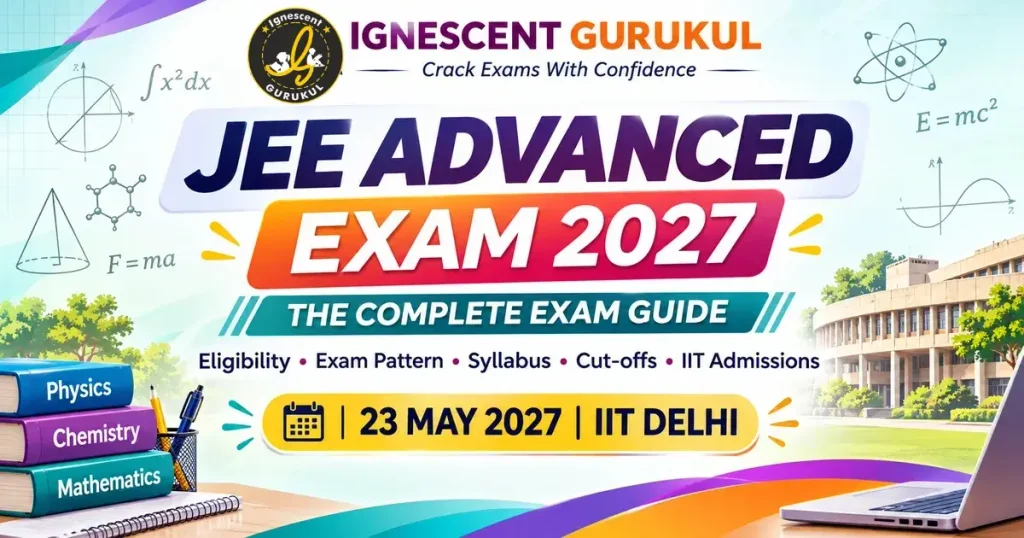
JEE Advanced 2027: Exam Date, Eligibility, Syllabus, Paper 1 & 2 Pattern, Cut-offs, Marks vs Rank, IIT Counselling & Free Sample Papers
Your complete JEE Advanced 2027 guide—from becoming eligible after JEE Main to solving challenging Physics, Chemistry and Mathematics problems and choosing an IIT through JoSAA. 2027 facts are distinguished from historical patterns.
Get a personalised IIT-JEE preparation plan
Tell our faculty your target and present preparation level. Ask about the 16 November 2026 JEE Main workshop or 1 February 2027 JEE Advanced workshop.
JEE Advanced 2027 at a glance
Verify official 2027 announcements · Official 2027 eligibility
Article contents
JEE Advanced 2027 important dates and schedule
| Event | Date or status | How to check |
|---|---|---|
| Organising institute | IIT Delhi (shown on the official 2027 homepage) | Official homepage |
| JEE Advanced 2027 exam | Sunday, 23 May 2027 (displayed by official website) | Recheck the official notice before final publication |
| JEE Main 2027 sessions and results | Consult NTA 2027 announcements | NTA JEE Main |
| Online registration opens / closes | To be confirmed through 2027 instructions | No 2026 dates should be reused |
| Fee payment deadline | To be confirmed | Official candidate portal |
| Admit card release / city intimation | To be confirmed | Official candidate portal |
| Paper 1 / Paper 2 reporting timings | 2027 timings pending; 2026 was 09:00–12:00 and 14:30–17:30 IST | Confirm on 2027 admit card |
| Candidate response sheets, provisional keys and objections | To be confirmed after examination | Official updates |
| Final answer keys, result / rank list | To be announced | Official portal |
| AAT application, test, result | To be announced | Official / JoSAA portal |
| JoSAA 2027 registration and choice filling | To be announced separately by JoSAA | JoSAA |
Check Official Website for Registration
What is JEE Advanced? How is it different from JEE Main?
JEE Advanced is the national entrance examination used for entry into specified undergraduate, integrated, and dual-degree programmes at the 23 Indian Institutes of Technology (IITs). The examination is conducted by the IIT system under the Joint Admission Board. JEE Main Paper 1 is conducted by the National Testing Agency and is primarily the entrance route for NITs, IIITs and GFTIs; it is also the qualification gateway to JEE Advanced for most Indian applicants. Other institutions can use JEE Advanced results subject to their admission rules.
| Feature | JEE Main (B.E./B.Tech.) | JEE Advanced |
|---|---|---|
| Purpose | NIT/IIIT/GFTI admission and Advanced shortlisting | Specified IIT degree admission and certain other programmes |
| Conducted by | National Testing Agency (NTA) | Organising IIT under JAB / seven zonal IIT structure |
| Stages | Often multiple sessions (confirm 2027 notification) | Normally one examination date, with both papers mandatory |
| 2026 question format | 75 questions, 300 marks; 20 MCQs + 5 numerical per subject | Two papers; varied single/multiple correct, numerical and matching/stem questions |
| Focus | Speed, accuracy and syllabus breadth | Depth, synthesis, reasoning and multi-concept problem-solving |
| Ranking | NTA score / JEE Main ranks | Separate JEE Advanced CRL and category ranks |
What admission programmes can follow an Advanced rank?
B.Tech., B.S., B.Arch. (with AAT qualification where required), dual degrees such as B.Tech.–M.Tech., B.S.–M.S. and integrated programmes, depending on the institute’s final seat matrix. For individual branch availability, duration, fee and degree specifications, use the official JoSAA seat matrix for the admission year.
JEE Advanced 2027 eligibility: age, attempts, Class 12 and IIT-admission history
These are published 2027 criteria, not a guess from older years. Indian-national candidates and OCI/PIO (I) applicants must meet all five criteria below at the same time:
A1 · JEE Main performance
Be within the top 2,50,000 eligible candidates in JEE Main 2027 B.E./B.Tech., including applicable category quotas and ties. Qualifying percentage alone does not ensure an IIT seat.
A2 · Date of birth
Born on or after 1 October 2002; relaxation for SC, ST and PwD applicants changes the threshold to 1 October 1997.
A3 · Maximum attempts
No more than two attempts in two consecutive years. Skipping a year does not create a third attempt.
A4 · First Class 12 appearance
Usually first appeared in the Class 12 or equivalent examination in 2026 or 2027 with Physics, Chemistry and Mathematics compulsory. A narrowly stated exception covers qualifying boards whose 2024–25 results were declared on or after 12 June 2025; read the official exception before assuming eligibility.
A5 · Previous IIT admission
Earlier acceptance/admission in an IIT programme can make a candidate ineligible. The 2027 eligibility notice specifies exceptions for first-time preparatory programme students in 2026 and some 2026 JoSAA allocations where the candidate did not report, withdrew before the final IIT allotment round, or had a seat cancelled before that round, provided A1–A4 are also met.
How are the top 2,50,000 JEE Main candidates distributed?
| Category | Illustrative official 2027 allocation |
|---|---|
| OPEN (including OPEN-PwD) | 1,01,250 |
| GEN-EWS (including PwD) | 25,000 |
| OBC-NCL (including PwD) | 67,500 |
| SC (including PwD) | 37,500 |
| ST (including PwD) | 18,750 |
| Overall | 2,50,000 (ties may increase this) |
Reservation among seats is distinct from the shortlisting pool. The historical IIT seat reservation baseline was 10% GEN-EWS, 27% OBC-NCL, 15% SC, 7.5% ST and 5% horizontal PwD, alongside supernumerary female seats designed to support at least 20% female enrolment. Confirm policy, category certificates and programme-level seat details from JoSAA 2027.
Foreign-national and OCI/PIO candidates
Foreign nationals and OCI/PIO (F) candidates can register without taking JEE Main, subject to four separate eligibility criteria, and are considered in addition to the Indian top-2,50,000 shortlist. Official 2027 rules describe supernumerary seats with caps and different reservation treatment. OCI/PIO status depends in part on card issuance and the applicable legal classification; applicants must use the exact 2027 official definitions and foreign-candidate guidance rather than assume every OCI cardholder is treated identically.
Is 75% in Class 12 required for IIT admission in 2027?
Separate the right to sit the exam from the right to receive an IIT seat. The published 2027 appearance criteria do not simply say that every applicant must first score 75% in Class 12 to write the Advanced paper. Under the 2026 IIT admission rules, qualifying candidates generally needed either at least 75% aggregate (65% for SC/ST/PwD) across the prescribed five subjects, or to rank within the category-wise top 20 percentile of successful candidates from their own board. Reconfirm the 2027 JoSAA rules before relying on this for a 2027 seat.
| Counted board subjects under 2026 rules | Method |
|---|---|
| Physics, Chemistry, Mathematics | All three compulsory |
| A language | Take the language with the higher marks if multiple |
| One other subject | Highest-scoring eligible fifth subject |
| Total | Normalize each subject to /100 where required; total /500 |
For improvement examinations, historical rules permitted improvement in one or more subjects for the percentage threshold, while improvement aimed at the top-20-percentile route required the prescribed complete-subject approach in one academic year. Results and certificates must comply with single-board requirements. Read official IIT admission criteria.
JEE Advanced registration steps, documents and fees
Once the 2027 portal opens, eligible JEE Main candidates should verify their credentials, complete their details, choose permitted exam cities and language, upload the requested certificates and photographs, pay the applicable fee, and save the confirmation. Confirm whether any corrections are permitted before submission.
| 2026 registration fee: centre in India | 2026 amount (historical, not 2027) |
|---|---|
| Female candidates (Indian nationals, all categories) | ₹1,600 |
| Indian SC / ST / PwD applicants | ₹1,600 |
| Other Indian candidates | ₹3,200 |
| OCI/PIO (I) GEN/PwD variants | ₹1,600 or ₹3,200 according to classification |
| Foreign / OCI/PIO (F) in SAARC countries | USD 100 or INR equivalent |
| Foreign / OCI/PIO (F) in non-SAARC countries | USD 200 or INR equivalent |
For 2026 centres abroad, the brochure specified different USD-based fees. Fees may exclude service charges and normally are non-refundable. Do not assume these 2026 prices apply to 2027.
Keep these ready
- JEE Main credentials (when applicable), active email address and mobile number.
- Class 10 date-of-birth proof and Class 12 details, as instructed.
- Identification, recent photograph, signature and payment facility, to current specifications.
- Category/disability, scribe, compensatory time, foreign-national or OCI/PIO documents if relevant; use the published 2027 formats and validity dates.
- Admit card and an original valid photo ID on exam day.
Consult the 2026 brochure for the historical document list; use only the fresh 2027 instructions to register.
JEE Advanced 2027 paper pattern, duration, marks and negative marking
Paper 1 and Paper 2 are separate, compulsory computer-based papers containing Mathematics, Physics and Chemistry. The 2026 brochure specified three hours for each paper, two paper slots on one day, bilingual English/Hindi content with on-screen language switching, and a marking scheme disclosed with the actual question papers. The 2027 version must be checked once its complete brochure is published.
| 2026 confirmed maximum | Paper 1 | Paper 2 | Combined |
|---|---|---|---|
| Mathematics | 60 | 60 | 120 |
| Physics | 60 | 60 | 120 |
| Chemistry | 60 | 60 | 120 |
| All subjects | 180 | 180 | 360 |
2027 total maximum marks: not assumed. The numerical table above belongs to 2026. IITs may change numbers of questions, marking and total marks in a later year. 2027 percentage-based cut-offs should be converted into marks only after official maximum marks and final qualifying percentages are announced.
Question formats candidates must practise
- Single-correct MCQ: only one of the options is correct; negative marking may apply.
- Multiple-correct MCQ: one or more options may be correct; partial credit and penalties depend on that paper’s section rules.
- Numerical value: type an integer or decimal to the instructed precision; some previous years had no negative marking on such questions.
- Matching/list or paragraph-linked items: interpret a common stem or pairs before choosing/entering answers.
- Partial marking: selecting only correct options can earn partial marks when the paper expressly allows it; adding an incorrect option may lose marks.
Before the test, read the Instructions to Candidates for each section. Never extrapolate a remembered +4/−2 rule across all questions. An abandoned question usually gets zero; the official question booklet controls the actual scoring.
Detailed JEE Advanced Paper 1 versus Paper 2 analysis: 2026 precedent
The following tables describe a historical 2026 paper layout reported from the published papers. They are helpful for practising variety, not a promise of a repeated 2027 layout.
Paper 1 · 2026 example (per subject)
| Section | Question type | Questions per subject | Historical marking | Section marks |
|---|---|---|---|---|
| 1 | One correct option | 4 | +3 correct, −1 incorrect, 0 unanswered | 12 |
| 2 | One or more correct options | 4 | +4 full; partial credit under section rules; −1 otherwise | 16 |
| 3 | Numerical value | 4 | +4 correct, zero otherwise | 16 |
| 4 | Matching lists | 4 | +4 correct, −1 incorrect, zero unanswered | 16 |
| Total per PCM subject | Four formats | 16 | — | 60 |
Paper 1 total, 2026: 48 questions across three subjects, maximum 180 marks.
Paper 2 · 2026 example (per subject)
| Section | Question type | Questions per subject | Historical marking | Section marks |
|---|---|---|---|---|
| 1 | One correct option | 4 | +3 correct, −1 incorrect, 0 unanswered | 12 |
| 2 | One or more correct options | 5 | +4 full, specified partial credit; negative otherwise | 20 |
| 3 | Numerical value | 5 | +4 correct, zero otherwise | 20 |
| 4 | Common stem with linked numerical items | 4 | +2 correct, zero otherwise | 8 |
| Total per PCM subject | Four formats | 18 | — | 60 |
Paper 2 total, 2026: 54 questions across three subjects, maximum 180. Combined 2026 paper count: 102. These detailed breakdowns are based on analysis of the 2026 examination papers; verify paper instructions against the originals.
How should students approach each paper?
Paper 1: develop fast identification of clean single-correct questions, then allocate longer blocks to numerical and matching items. Paper 2: practise avoiding over-selection in multi-correct items, reading common stems once, and assigning time to calculations with low risk of careless input. In both, protect the subject-wise qualifying threshold as well as aggregate marks.
Download official previous papers and time Paper 1 and 2 on the same day to rehearse fatigue and concentration.
JEE Advanced 2027 syllabus: detailed Physics, Chemistry and Maths checklist
This is a learning-oriented chapter map built from the official 2026 syllabus (Annexure I), not a claim that every exact line has already been reconfirmed in a 2027 brochure. For the legally controlling topic list, always use the upcoming 2027 official syllabus. Do not assume deleted topics from JEE Main are automatically deleted from Advanced.
Physics · detailed preparation checklist
Units, measurement and experiments
SI units; dimensional analysis; error estimation; significant figures; least count; vernier and screw gauge; graph reading; common experimental arrangements.
Mechanics
1D and 2D kinematics; relative motion; vectors; laws of motion; free-body diagrams; friction; circular motion; work–energy–power; centre of mass; collisions; impulse; rotational dynamics, moment of inertia, torque and rolling; gravitation; escape and orbital motion; fluid statics/dynamics, Bernoulli; elasticity and viscosity; surface tension.
Oscillations and waves
SHM, restoring-force energy and phase, spring/pendulum systems; wave speed, superposition, interference, standing waves, sound waves, resonance, beats and Doppler effect.
Thermal physics
Temperature, calorimetry, thermal expansion, heat transfer; ideal gases, kinetic theory, molecular speeds; first and second laws of thermodynamics; processes and heat engines.
Electricity and magnetism
Coulomb law, potential, Gauss law, capacitors and dielectrics, current circuits, cells, Kirchhoff laws, heating; Biot–Savart, Ampère, Lorentz force, magnetic torque, induction, Lenz law, AC, LCR circuits and EM waves.
Optics
Mirrors, refraction, thin lenses, lens combinations, prism; interference including YDSE, diffraction, polarization, microscope and telescope; optical instruments.
Modern physics
Photoelectric effect, de Broglie matter waves, Bohr atom, nuclei, radioactivity, mass defect, binding energy, nuclear fission/fusion and related experimental concepts.
Chemistry · detailed preparation checklist
Physical chemistry
Mole concept and stoichiometry; atomic structure; gaseous/liquid/solid states; chemical bonding and molecular structure; chemical and ionic equilibrium; thermodynamics/thermochemistry; solutions and colligative properties; electrochemistry; chemical kinetics; surface chemistry and adsorption.
Inorganic chemistry
Periodicity; hydrogen; s-, p-, d- and f-block chemistry; coordination chemistry (CFT/VBT, isomerism and magnetism); metallurgy; qualitative inorganic analysis; characteristic trends and reactions of important compounds.
Organic chemistry
Purification and analysis; IUPAC naming; GOC, electronic effects, acidity/basicity, intermediates; stereochemistry/isomerism; alkanes, alkenes, alkynes and aromatic systems; alkyl halides and haloarenes; alcohols, phenols, ethers; aldehydes, ketones, carboxylic acids; amines, diazonium salts; biomolecules, polymers, practical identification.
Extra listed themes in historical syllabus
Environmental chemistry, chemistry in everyday life, and some topics not identical to the then-current JEE Main syllabus. Always compare the two official 2027 syllabi separately.
Mathematics · detailed preparation checklist
Sets, relations and functions
Set operations, De Morgan, equivalence relations, domain/range, injective/surjective functions, inverses, composite functions, graphs, logarithmic/exponential functions.
Algebra and sequences
Complex numbers and loci; quadratic equations and theory of roots; arithmetic/geometric progressions; permutation–combination; binomial theorem; induction-based reasoning where applicable.
Matrices and determinants
Matrix algebra, transpose, inverse, minors, determinants up to 3×3, row/column transformations and systems of equations.
Trigonometry
Identities, inverse trigonometric functions, equations, periodicity and transformations.
Coordinate geometry
Straight lines, circles, parabolas, ellipses, hyperbolas, tangents/normals, locus and conics.
Vector algebra and 3D
Dot/cross products, triple products, lines and planes, distances and angles, shortest distance between skew lines.
Calculus
Limits, continuity, differentiability; differentiation; mean value theorems; maxima/minima; integration/substitution, partial fractions, integration by parts and definite integral properties; area under curves; first-order differential equations.
Probability and statistics
Counting-based probabilities, conditional probability, independent events, Bayes theorem, random variables and basic descriptive statistics.
High-scoring topics, chapter priorities and marks-wise preparation strategy
There is no officially guaranteed chapter-wise number of marks in JEE Advanced 2027. The following are Ignescent Gurukul suggested allocations of preparation time, not historical mark distributions or expected question weights. Weights add to 100% within each subject.
Physics: recommended share of revision time
| Study cluster | Suggested preparation time |
|---|---|
| Mechanics, rotation, fluids, gravitation | 30% |
| Electricity, magnetism, AC and EM induction | 27% |
| Heat, thermodynamics and kinetic theory | 13% |
| Optics | 12% |
| Waves and oscillations | 10% |
| Modern physics / experimental skills | 8% |
Chemistry: recommended share of revision time
| Study cluster | Suggested preparation time |
|---|---|
| Physical chemistry calculation clusters | 36% |
| Organic chemistry mechanisms and synthesis | 35% |
| Inorganic, qualitative, coordination and periodic chemistry | 29% |
Mathematics: recommended share of revision time
| Study cluster | Suggested preparation time |
|---|---|
| Calculus and differential equations | 32% |
| Algebra, complex numbers, matrices and probability | 30% |
| Coordinate geometry and conics | 23% |
| Vectors, 3D and trigonometry | 15% |
How should you set score targets?
Instead of treating 180 or 360 as guaranteed for 2027, set three tiers from timed mocks: qualifying safety (clear every subject minimum), competitive rank (balanced correct attempts in all three), and branch-specific stretch (choose from real JoSAA closing ranks, not rumours). Keep a chapter dashboard with attempted, correct, error type, time per question and accuracy after each CBT.
JEE Advanced previous three years cut-offs (2026, 2025, 2024)
These are actual minimum marks for inclusion in a JEE Advanced rank list, not the minimum marks for a popular IIT branch. Each year shown had a maximum of 360 marks; qualifying required both aggregate AND individual subject minimums.
| Rank list | 2026 aggregate / 360 | 2025 aggregate / 360 | 2024 aggregate / 360 |
|---|---|---|---|
| CRL (OPEN) | 92 | 74 | 109 |
| GEN-EWS / OBC-NCL | 82 | 66 | 98 |
| SC / ST / PwD variants | 46 | 37 | 54 |
| Preparatory rank list | 23 | 18 | 27 |
| Rank list | 2026 minimum EACH PCM subject / 120 | 2025 | 2024 |
|---|---|---|---|
| CRL | 8 | 7 | 10 |
| GEN-EWS / OBC-NCL | 7 | 6 | 9 |
| SC / ST / PwD | 4 | 3 | 5 |
| Preparatory list | 2 | 1 | 2 |
Why does the 2026 brochure say 35% while the final CRL cut-off was 92?
The preliminary 2026 brochure gave a 35% aggregate and 10% per subject CRL standard. The published post-examination 2026 result release shows 92/360 aggregate and 8/120 per subject as the final CRL list threshold. The brochure allowed the aggregate benchmark to be lowered under specified policy; do not confuse preliminary percentages with actual result cut-offs. The 2027 list thresholds will be known only through the relevant 2027 documents.
Reference: 2026 official result release, 2025 report, 2024 report.
JEE Advanced marks versus rank: 2026 historical benchmarks
Raw scores and rank are not a fixed conversion: difficulty, candidate performance, paper structure and tie-breaking change each year. Below are selected 2026 CRL observations, not predictions for 2027. They are useful only as a reference to plan mock targets.
| 2026 CRL (approximate rank landmark) | 2026 observed marks / 360 |
|---|---|
| AIR 1 | 330 |
| AIR 101 | 274 |
| AIR 501 | 233 |
| AIR 1,001 | 209 |
| AIR 2,001 | 186 |
| AIR 3,001 | 172 |
| AIR 5,001 | 155 |
| AIR 10,001 | 131 |
| AIR 15,001 | 117 |
Source: College Pravesh 2026 CRL rank-versus-marks table, checked 13 November 2026. Selected points are not a 2027 rank predictor.
How does the AIR tie-break work?
Historically, ties in aggregate marks were separated first by higher positive marks, then mathematics marks, then physics marks. If still tied, the same rank was awarded. Confirm this procedure for 2027 in its official brochure.
What score is enough for IIT Bombay CSE, IIT Delhi CSE or IIT Kharagpur?
There is no dependable universal marks target for a branch. Seat allocation uses rank, seat category, gender pool, eligibility, choices and availability. See 2026 official JoSAA opening/closing rank tool; switch to the proper 2027 round once available. Open-seat closing ranks are CRL; reserved-seat closing ranks in the system are category ranks.
IIT college allotment and JoSAA counselling: step-by-step process
- Qualify the examination. Obtain a JEE Advanced 2027 rank and satisfy Class 12, nationality and any programme-specific criteria.
- Register on the official JoSAA portal. Check the admission year and mandatory registration date; JEE Advanced registration does not itself constitute JoSAA counselling registration.
- Explore the seat matrix. Compare institute, degree, branch, duration, category pool, fee and eligibility restrictions.
- Fill and order choices. Put your true preferred programmes first; do not order only by last year’s closing rank.
- Lock / verify choices. Follow official portal steps and keep screenshots or acknowledgement.
- Read mock allotments (if released). Use them to evaluate choice order but do not treat them as a guarantee.
- Review each round’s seat allocation. Read provisional seat, category and reporting instructions carefully.
- Choose willingness: Freeze (keep allotted choice), Float (consider preferred programmes across institutes as permitted), or Slide (consider a better preference within the allotted institute), in accordance with that year’s rules.
- Complete seat acceptance. Upload documents, pay the seat acceptance fee, and address queries/verification on time, or risk losing the seat.
- Report / institute admission. Comply with the final institute’s fee, physical reporting, medical and original document requirements.
| Where to look | Official link |
|---|---|
| JoSAA main information | josaa.nic.in |
| Current official opening & closing ranks | JoSAA rank tool |
| Past years archives | JoSAA rank archive |
| Business rules / reporting / fees | JoSAA business rules |
Do I need JEE Advanced for NITs and IIITs?
Generally no: JEE Main rank is used for JoSAA admission to NITs, IIITs and many GFTIs, while IIT allocation requires a qualifying Advanced rank and all relevant eligibility. Some institutions and special programmes have independent arrangements; always verify their current admission notice.
Common mistakes in counselling
- Confusing a CRL rank with OBC-NCL/SC/ST/EWS category rank in closing-rank tables.
- Assuming historical closing ranks are a guaranteed admission threshold.
- Not checking branch-specific restrictions, fee, home-state quota (for non-IIT institutes), or documents.
- Missing the online reporting, willingness selection or payment deadline.
- Assuming that one seat-allotment status never changes between rounds.
JEE Advanced admit card, exam cities, language, instructions and accessibility
Admit card and identity
Download from the official candidate portal once released. Check your name, photograph, allotted examination city/centre, reporting time, category and accessibility accommodations. Under 2026 rules, candidates brought a printed admit card and an original acceptable photo ID. Candidates were told to reach the centre early, with doors closing at the commencement of each paper.
What can be taken into the test hall? (2026 reference)
Allowed historically: printed admit card, original photo ID, pen/pencil and a transparent water bottle. Prohibited items included phones, watches, Bluetooth devices, calculators, notes, log tables, bags and many metal accessories. An on-site scribble pad was provided for rough work. Follow the 2027 admit card instructions, not this historical list alone.
English and Hindi
Previous exam papers offered English and Hindi, with on-screen switching. The English wording prevailed in an interpretation discrepancy. The actual 2027 options must be confirmed with the exam authority.
PwD, scribe and compensatory time
The 2026 brochure provided eligible PwD candidates and certain candidates with a qualifying writing difficulty compensatory time (typically one additional hour per paper) and permitted scribe arrangements subject to medical certificates, prescribed forms and advance registration. Eligibility depends on the legally prescribed categories, not a blanket request. Read the 2027 notice for the latest paperwork and procedures.
Response sheets and answer keys
After both compulsory papers, candidate responses and provisional keys were historically posted through the portal. A limited window was provided for objections; final keys determined marks. Download official documents promptly. If a question is formally dropped, the applicable examination’s announced award rule governs it.
What is AAT? Can JEE Advanced lead to B.Arch.?
Candidates seeking IIT B.Arch. programmes must check the Architecture Aptitude Test (AAT) process. The 2026 brochure named IIT (BHU) Varanasi, IIT Kharagpur and IIT Roorkee for its B.Arch. pathway. AAT was open to candidates qualified in Advanced and required separate registration. Passing AAT can be necessary for B.Arch. eligibility, but seat allotment still depends on the Advanced rank and JoSAA rules. The precise 2027 institutes, exam, syllabus and passing standard must be confirmed.
Typical AAT preparation areas include drawing/visualisation, geometric understanding, three-dimensional perception, aesthetic sensitivity and architectural awareness. Use the current official JEE Advanced site for AAT instructions rather than guessing the 2027 pattern.
Three genuine JEE Advanced 2025 previous-year question concepts with solutions
These are three genuine JEE Advanced 2025 Paper 1 question ideas, identified by their official question numbers but independently paraphrased here. We provide original worked explanations rather than copying the full copyrighted question text or figures. Always check the official 2025 Paper 1 for the exact original.
2025 Paper 1 · Mathematics Q1 · coefficient of x³ in shifted quartic difference
Condensed problem: Two monic quartics obey f(x)≠g(x) for every real x and have the form f(x)=x⁴+a₃x³+a₂x²+10x+a₁ and g(x)=x⁴+b₃x³+b₂x²+3x+b₁. Calculate the coefficient of x³ in h(x)=f(x+1)−g(x+2).
Step 1: In (x+c)⁴, the x³ coefficient is 4c. Thus f(x+1) contributes 4 from its quartic term; g(x+2) contributes 8.
Step 2: The x³ coefficient of a₃(x+1)³ is a₃, and of b₃(x+2)³ is b₃. Lower-degree terms cannot supply x³.
Step 3: The original condition says f(x)≠g(x) for every real x. If f−g had nonzero cubic leading term, it would be an odd-degree real polynomial and must have a real zero; contradiction. Hence a₃=b₃ and cubic terms cancel. So coefficient = 4−8 = −4.
Answer: −4. Learning point: for a shifted degree-n monic polynomial, the next-highest coefficient changes predictably by n times the translation.
2025 Paper 1 · Chemistry Q1 · thermal decomposition of ammonium salts
Condensed problem: On moderate heating, identify the nitrogen-containing products from ammonium nitrite and ammonium nitrate, respectively.
Step 1: Write balanced equations and check atom conservation: NH₄NO₂ → N₂ + 2H₂O and NH₄NO₃ → N₂O + 2H₂O under the stated heating conditions.
Step 2: The nitrogen product of nitrite is molecular nitrogen N₂; that of nitrate is nitrous oxide N₂O. The oxygen accounting and the change in oxidation states support the distinction.
Answer: N₂, then N₂O. Learning point: one removed oxygen atom changes the preferred decomposition product. These are textbook idealized products; laboratory safety is essential and this is not a practical instruction to heat these chemicals.
2025 Paper 1 · Physics Q1 · rolling disc in a circular ring with a spring
Condensed problem: A uniform disc of mass m and radius r rolls without slipping inside a fixed vertical circular ring of radius R (R>r), and its centre is spring-coupled with stiffness k along the tangential direction. Find the small-oscillation angular frequency about the bottom equilibrium.
Step 1: The centre follows a circle of radius L=R−r. For a small angular displacement θ, tangential displacement s=Lθ and vertical rise ≈s²/(2L).
Step 2: Gravitational potential is U_g≈mg s²/(2L). Spring energy is U_s≈k s²/2. Thus effective restoring coefficient is k_eff=k+mg/L.
Step 3: Rolling without slipping gives rotational kinetic energy in addition to translation. For a solid disc, I=mr²/2, so T=½(m+I/r²)(ds/dt)²=½(3m/2)(ds/dt)².
Step 4: Therefore ω²=k_eff/(3m/2)=(2/3)[k/m+g/(R−r)].
Answer: ω=√{(2/3)[g/(R−r)+k/m]}. Learning point: include rotational inertia when rolling; treating the object as a sliding particle gives the wrong factor.
JEE Advanced Paper 1 and Paper 2 sample papers + JEE Main 75-question sample
These three original Ignescent Gurukul sample papers are placed directly in this article for immediate practice. Advanced Paper 1 and Paper 2 below are short illustrative sets rather than full official exam replicas; the JEE Main Paper 1 set contains 75 original questions in the 2026 20-MCQ/5-numerical-per-subject arrangement. They deliberately range from foundation-building to intermediate problems and should not be represented as leaked or predicted 2027 examination questions.
JEE Advanced Paper 1 · A Quick Boost
Original illustrative mini-paper · 18 questions (6 per subject). This is NOT a full official three-hour question paper and is intentionally shorter than the 2026 examination. Suggested self-study: 65 minutes. Single / multi / numeric types are for familiarity, not an official 2027 scoring forecast.
Physics
A 2 kg particle starts from rest; a constant net force of 6 N acts for 4 s. Final momentum (kg m/s)?
Answer & worked explanation
Answer: 24
Impulse FΔt=6×4=24 N s. Correct answer is 24.
A mass m on an ideal spring k has its mass quadrupled. How does its time period change?
Answer & worked explanation
Answer: 2 times
T∝√m; √4=2.
For an ideal conductor in electrostatic equilibrium, which hold: (A) field inside bulk zero; (B) potential constant throughout conductor; (C) net charge may occupy outer surface; (D) electric field must be nonzero inside?
Answer & worked explanation
Answer: A, B, C
Shielding implies E=0 in bulk, so potential constant; excess charge may lie on surface.
For SHM x=A cos(ωt), choose true: (A) v max at x=0; (B) acceleration zero at x=0; (C) total energy varies periodically; (D) |a| max at turning points.
Answer & worked explanation
Answer: A, B, D
v²=ω²(A²−x²), a=−ω²x; ideal total energy stays constant.
A 5 μF capacitor across 200 V stores energy, in units of 10⁻² J. Enter a number.
Answer & worked explanation
Answer: 10
E=½CV²=½×5×10⁻⁶×40000=0.1 J=10×10⁻² J.
A 30 cm focal-length convex lens has an object at 60 cm. Magnitude of image distance in cm?
Answer & worked explanation
Answer: 60
Lens equation 1/f=1/v−1/u with u=−60 gives v=60 cm.
Chemistry
What is the oxidation number of sulfur in SO₄²⁻?
Answer & worked explanation
Answer: +6
x+4(−2)=−2 so x=+6.
Which species is diamagnetic: O₂, N₂, NO, O₂⁻?
Answer & worked explanation
Answer: N₂
All electrons paired in N₂ molecular orbitals.
Ideal gas at fixed T: select correct (A) PV constant for fixed n; (B) mean kinetic energy depends on T; (C) doubling volume doubles pressure; (D) pressure due to molecular collisions.
Answer & worked explanation
Answer: A, B, D
Boyle law, kinetic theory, pressure inversely with volume.
Which can donate an electron pair: (A) NH₃; (B) H₂O; (C) BF₃; (D) Cl⁻?
Answer & worked explanation
Answer: A, B, D
Lone-pair donors are Lewis bases; BF₃ is an electron-pair acceptor.
For 0.2 mol solute in 500 mL solution, molarity (mol L⁻¹)?
Answer & worked explanation
Answer: 0.4
M=n/V=0.2/0.5=0.4.
A reaction has half-life 10 min and obeys first-order kinetics. Fraction of starting material remaining after 30 min, as a decimal?
Answer & worked explanation
Answer: 0.125
Three half-lives: (1/2)³=1/8=0.125.
Mathematics
If z=3+4i, what is |z|?
Answer & worked explanation
Answer: 5
√(3²+4²)=5.
Number of distinct permutations of the letters in LEVEL?
Answer & worked explanation
Answer: 30
5!/(2!2!)=30.
For f(x)=x² on ℝ, choose true: (A) even; (B) injective on ℝ; (C) range [0,∞); (D) differentiable for all real x.
Answer & worked explanation
Answer: A, C, D
Even, many-to-one globally, nonnegative range, polynomial differentiable.
If vectors a and b are nonzero and perpendicular: (A) a·b=0; (B) |a×b|=|a||b|; (C) a×b=0; (D) angle 90°.
Answer & worked explanation
Answer: A, B, D
Dot product vanishes, cross magnitude maximal.
Evaluate ∫₀² 3x² dx.
Answer & worked explanation
Answer: 8
Integral is [x³]₀²=8.
A fair die is thrown twice. Number of ordered outcomes with sum 7?
Answer & worked explanation
Answer: 6
(1,6),(2,5),(3,4),(4,3),(5,2),(6,1).
JEE Advanced Paper 2 · A Quick Check
Original illustrative mini-paper · 18 questions (6 per subject). This is NOT a full official three-hour question paper and is intentionally shorter than the 2026 examination. Suggested self-study: 65 minutes. Single / multi / numeric types are for familiarity, not an official 2027 scoring forecast.
Physics
A body moves around a circle of radius 2 m at 4 m/s. Magnitude of centripetal acceleration?
Answer & worked explanation
Answer: 8 m/s²
a=v²/r=16/2=8.
For a photoelectric emitter operating above threshold, photon energy is doubled while its work function is unchanged. The stopping potential necessarily: increases, decreases, stays, or vanishes?
Answer & worked explanation
Answer: Increases
Kmax=hν−φ. Doubling photon energy increases max kinetic energy and stopping voltage.
For a pure resistor driven by AC voltage: (A) current in phase with voltage; (B) average power positive; (C) power factor zero; (D) current rms=V rms/R.
Answer & worked explanation
Answer: A, B, D
No reactance: cosφ=1, not zero.
Regarding an ideal transformer: (A) works on AC; (B) voltage ratio = turns ratio; (C) power in≈power out; (D) increases frequency.
Answer & worked explanation
Answer: A, B, C
Faraday induction, approximate power conservation, no frequency change.
A ball falls freely through 20 m from rest. Take g=10 m/s². Final speed (m/s)?
Answer & worked explanation
Answer: 20
v²=2gh=400, v=20.
Two 4 Ω resistors in parallel yield equivalent resistance in ohms?
Answer & worked explanation
Answer: 2
1/R=1/4+1/4=1/2.
Chemistry
At 25°C, which has lower pH: 10⁻³ M HCl or 10⁻⁵ M HCl?
Answer & worked explanation
Answer: 10⁻³ M HCl
Strong acid: more hydrogen ions, smaller pH.
What is the shape of methane?
Answer & worked explanation
Answer: Tetrahedral
Four bond pairs at carbon, sp³ geometry.
Which are intensive: (A) temperature; (B) density; (C) mass; (D) pressure.
Answer & worked explanation
Answer: A, B, D
Independent of system size; mass is extensive.
For an equilibrium reaction, choose true: (A) catalyst changes equilibrium constant; (B) catalyst speeds both forward and reverse; (C) equilibrium dynamic; (D) concentrations always equal.
Answer & worked explanation
Answer: B, C
Catalyst does not change equilibrium position; rates equal at dynamic equilibrium.
Atomic mass of X is 12 g mol⁻¹. Mass in grams of 0.75 mol?
Answer & worked explanation
Answer: 9
0.75×12=9.
A 1 M strong monoprotic acid is diluted tenfold. Approximate pH after dilution?
Answer & worked explanation
Answer: 1
[H+]=0.1 M→pH=1.
Mathematics
Differentiate ln(x²+1) with respect to x.
Answer & worked explanation
Answer: 2x/(x²+1)
Chain rule f’/f with f=x²+1.
If roots of x²−7x+12=0 are α,β, what is αβ?
Answer & worked explanation
Answer: 12
Vieta: constant coefficient / leading coefficient.
For a square matrix A of order 2, which hold: (A) det(Aᵀ)=det A; (B) det(2A)=4 det A; (C) det(A⁻¹)=1/det A if invertible; (D) det(A+B)=det A+det B always.
Answer & worked explanation
Answer: A, B, C
Transpose, scalar power n, inverse determinant; determinant not additive.
For f(x)=sin x: (A) odd; (B) period 2π; (C) maximum value 2; (D) derivative cos x.
Answer & worked explanation
Answer: A, B, D
Sine range is [−1,1].
Evaluate limₓ→₀ sin(5x)/x.
Answer & worked explanation
Answer: 5
Standard sin u/u→1, multiply by 5.
Two independent fair coin tosses: how many ordered outcomes?
Answer & worked explanation
Answer: 4
HH, HT, TH, TT.
JEE Main Paper 1 · full 75-question original practice sample
2026-based allocation: Physics 20 MCQ + 5 numerical, Chemistry 20 MCQ + 5 numerical, Mathematics 20 MCQ + 5 numerical. Three-hour / 300-mark full-length format historically. Marking reference: +4 correct, −1 wrong and 0 unanswered for both MCQ and numerical questions in the 2026 pattern. The 2027 NTA bulletin controls its actual marking. Each question below includes a concise solution under an expandable answer.
Physics · 20 MCQs
SI unit of momentum?
Reveal answer & reasoning
Correct option: B
p=mv.
Displacement of uniformly moving body after 5 s at 3 m/s?
Reveal answer & reasoning
Correct option: C
s=vt=15.
Work done by a 10 N force parallel to a 4 m displacement?
Reveal answer & reasoning
Correct option: C
W=Fs=40 J.
Kinetic energy of 2 kg object moving at 3 m/s?
Reveal answer & reasoning
Correct option: C
½mv²=9 J.
At the highest point of vertical projectile motion, acceleration is:
Reveal answer & reasoning
Correct option: B
Gravitational acceleration persists downward.
For a simple pendulum with small oscillations, time period is proportional to:
Reveal answer & reasoning
Correct option: A
T=2π√(L/g).
A 6 Ω and a 3 Ω resistor in series have equivalent resistance:
Reveal answer & reasoning
Correct option: C
Series resistances add.
Two 6 Ω resistors in parallel combine to:
Reveal answer & reasoning
Correct option: A
Equal parallel resistors give R/2.
Electric power of appliance at 200 V drawing 2 A?
Reveal answer & reasoning
Correct option: C
P=VI=400.
Dimensional formula of force?
Reveal answer & reasoning
Correct option: B
F=ma.
Radius of curvature of a spherical mirror of focal length 15 cm?
Reveal answer & reasoning
Correct option: C
R=2f.
Photon energy is proportional to:
Reveal answer & reasoning
Correct option: B
E=hν.
Magnetic force on a moving charge is zero if v is:
Reveal answer & reasoning
Correct option: B
F=qvB sinθ.
After a body completes one full circular lap, displacement is:
Reveal answer & reasoning
Correct option: C
Initial and final positions coincide.
Universal gravitational attraction between two masses varies as:
Reveal answer & reasoning
Correct option: D
Newton gravitational law.
The SI unit of capacitance is:
Reveal answer & reasoning
Correct option: B
C=Q/V.
The unit of electric field is:
Reveal answer & reasoning
Correct option: A
E=F/q.
If frequency of a wave is doubled at fixed speed, wavelength becomes:
Reveal answer & reasoning
Correct option: B
λ=v/f.
An ideal gas at fixed temperature obeys:
Reveal answer & reasoning
Correct option: B
Boyle law.
A neutral atom becomes a positive ion by:
Reveal answer & reasoning
Correct option: B
Electron loss creates a positive ion.
Physics · 5 numerical-answer items
A 2 kg object accelerates at 5 m/s². Find net force in N.
Reveal numerical answer & reasoning
Answer: 10
F=ma=10 N.
A 10 V battery sends 2 A through a resistor. Resistance in Ω?
Reveal numerical answer & reasoning
Answer: 5
R=V/I=5 Ω.
A force of 4 N acts for 3 s. Find impulse in N s.
Reveal numerical answer & reasoning
Answer: 12
FΔt=12.
A wave has frequency 50 Hz and wavelength 2 m. Speed in m/s?
Reveal numerical answer & reasoning
Answer: 100
v=fλ=100.
A 5 kg object is lifted vertically by 2 m; take g=10 m/s². Gain in PE (J)?
Reveal numerical answer & reasoning
Answer: 100
mgh=100.
Chemistry · 20 MCQs
Avogadro constant is approximately:
Reveal answer & reasoning
Correct option: A
Fundamental mole definition.
Molar mass of H₂O (g/mol)?
Reveal answer & reasoning
Correct option: C
2(1)+16.
pH of a 0.01 M ideal strong monoprotic acid?
Reveal answer & reasoning
Correct option: B
−log10(10⁻²)=2.
Oxidation state of oxygen in most ordinary oxides?
Reveal answer & reasoning
Correct option: D
Typically −2 (exceptions include peroxides).
Atomic number determines number of:
Reveal answer & reasoning
Correct option: B
Z=protons.
An sp³ carbon typically has bond angle nearest:
Reveal answer & reasoning
Correct option: B
Tetrahedral.
Which is a strong electrolyte in dilute aqueous solution?
Reveal answer & reasoning
Correct option: C
Sodium chloride dissociates.
When pressure increases, boiling point of a liquid generally:
Reveal answer & reasoning
Correct option: B
Higher vapour pressure needed.
Which is a noble gas?
Reveal answer & reasoning
Correct option: B
Group 18.
Chemical formula of quicklime?
Reveal answer & reasoning
Correct option: B
Calcium oxide.
For a first-order reaction, unit of rate constant is:
Reveal answer & reasoning
Correct option: A
rate=k[A].
Which can form hydrogen bonds with water?
Reveal answer & reasoning
Correct option: B
Ammonia has hydrogen-bond donors/acceptors.
In the periodic table, atomic radius typically decreases across a period because:
Reveal answer & reasoning
Correct option: A
Effective nuclear charge rises.
A catalyst changes:
Reveal answer & reasoning
Correct option: B
Alternate pathway with lower activation barrier.
Geometrical isomerism is possible in:
Reveal answer & reasoning
Correct option: B
Each C of C=C has two different substituents.
Which ligand is typically neutral?
Reveal answer & reasoning
Correct option: C
Ammonia ligand is neutral.
A species accepting an electron pair is a:
Reveal answer & reasoning
Correct option: A
Lewis acid definition.
For pure water at 25°C, pH is near:
Reveal answer & reasoning
Correct option: C
Neutral pH at 25°C.
An aldehyde gives positive Tollens test because it:
Reveal answer & reasoning
Correct option: B
Aldehyde oxidised, Ag+ reduced.
Chemical bond formed by sharing electron pairs:
Reveal answer & reasoning
Correct option: B
Covalent bonding.
Chemistry · 5 numerical-answer items
Moles in 44 g CO₂ (molar mass 44 g/mol)?
Reveal numerical answer & reasoning
Answer: 1
n=m/M=1.
pH of 10⁻⁴ M ideal HCl?
Reveal numerical answer & reasoning
Answer: 4
−log10(10⁻⁴)=4.
Mass of 2 mol O₂ in grams (atomic mass O=16)?
Reveal numerical answer & reasoning
Answer: 64
M=32 g/mol ×2.
Electrons in neutral carbon atom (atomic number 6)?
Reveal numerical answer & reasoning
Answer: 6
Neutral atoms: electrons=protons.
Number of atoms in one H₂O molecule?
Reveal numerical answer & reasoning
Answer: 3
Two hydrogen + one oxygen.
Mathematics · 20 MCQs
Derivative of x³?
Reveal answer & reasoning
Correct option: C
Power rule.
∫2x dx equals:
Reveal answer & reasoning
Correct option: A
Antiderivative x².
sin²θ+cos²θ equals:
Reveal answer & reasoning
Correct option: B
Pythagorean identity.
If log₁₀x=2, x is:
Reveal answer & reasoning
Correct option: C
x=10².
Sum of roots of x²−5x+6=0?
Reveal answer & reasoning
Correct option: B
Vieta sum 5.
det([[1,2],[3,4]]) =
Reveal answer & reasoning
Correct option: A
1×4−2×3=−2.
Number of subsets of a 3-element set:
Reveal answer & reasoning
Correct option: C
2³=8.
Probability of getting a head on one fair coin toss:
Reveal answer & reasoning
Correct option: C
One favourable outcome of two.
Distance from (0,0) to (3,4):
Reveal answer & reasoning
Correct option: B
Pythagorean theorem.
Area of circle of radius 2:
Reveal answer & reasoning
Correct option: B
πr²=4π.
What is the greatest real constant c such that x²≥c for every real x?:
Reveal answer & reasoning
Correct option: B
Nonnegative square.
Value of i²:
Reveal answer & reasoning
Correct option: A
Imaginary unit property.
Sum of first 10 positive integers:
Reveal answer & reasoning
Correct option: C
n(n+1)/2=55.
Solve 2x+3=11:
Reveal answer & reasoning
Correct option: C
2x=8.
tan 45° equals:
Reveal answer & reasoning
Correct option: B
Standard angle.
Number of permutations of 4 distinct objects:
Reveal answer & reasoning
Correct option: D
4!=24.
Slope of y=−3x+4 is:
Reveal answer & reasoning
Correct option: A
Coefficient of x.
limₓ→₀ sin x / x equals:
Reveal answer & reasoning
Correct option: B
Standard limit.
If A={1,2} and B={2,3}, A∩B is:
Reveal answer & reasoning
Correct option: C
Common element is 2.
The derivative of eˣ is:
Reveal answer & reasoning
Correct option: A
Exponential differentiates to itself.
Mathematics · 5 numerical-answer items
Value of 5! ?
Reveal numerical answer & reasoning
Answer: 120
5×4×3×2×1=120.
Compute 2³+3².
Reveal numerical answer & reasoning
Answer: 17
8+9=17.
If x=3, evaluate x²+2x.
Reveal numerical answer & reasoning
Answer: 15
9+6=15.
Number of diagonals in a hexagon?
Reveal numerical answer & reasoning
Answer: 9
n(n−3)/2=6×3/2=9.
Evaluate ∫₀³ 2x dx.
Reveal numerical answer & reasoning
Answer: 9
[x²]₀³=9.
How to prepare for JEE Advanced 2027: a high-precision roadmap
Phase 1 · Close the JEE Main knowledge gaps
List every weak Class 11 and 12 concept, align with the official Main and Advanced syllabi separately, complete NCERT and selected higher-order problems, and take timed CBT checkpoints. Avoid leaving a repeatedly incorrect chapter simply because you dislike it.
Phase 2 · Build Advanced-level reasoning
For each concept solve: one basic demonstration, one two-concept application, one non-routine constraint problem and one previous-year question. Make students explain the conditions for using each formula instead of remembering a single numerical pattern.
Phase 3 · Master answer types
Drill single-correct MCQs, multi-correct with partial-credit rules, precise integer/decimal numerical entries and matching/list questions. Use an error notebook classified as conceptual, algebraic, data-interpretation, wrong assumption, time pressure or careless input.
Phase 4 · Full-day examinations
Rehearse two three-hour sessions with a lunch break, timing restrictions, both-paper fatigue and subject-wise score tracking. Compare accuracy as well as attempts. Review each mock for at least as long as the time spent solving its difficult questions.
Seven-day sample micro-cycle
| Day | Main focus |
|---|---|
| Monday | Physics mixed-topic drill + previous-week error audit |
| Tuesday | Chemistry mechanism/physical/inorganic integration |
| Wednesday | Mathematics multi-concept and graph problems |
| Thursday | Timed integer/multiple-correct blocks; doubt corrections |
| Friday | Mixed PCM speed–precision micro-tests |
| Saturday | Timed Advanced-style Paper 1 practice + analytical feedback |
| Sunday | Timed Advanced-style Paper 2 practice + next-week remediation |
Exam-hall strategy
- Read section-wise marking instructions before attempting a question.
- Start with reliably solvable questions; do not allow one attractive problem to consume an entire section.
- Use rough work systematically, check units and numerical precision before entering a value.
- On multi-correct, do not guess extra options when negative marking is substantial.
- Protect subject-wise eligibility thresholds, but remember rank depends on aggregate.
- Take breaks, sleep well, and never rely on a predicted question list or unofficial leaked papers.
Ignescent Gurukul JEE Main and JEE Advanced 2027 workshops
60 Days JEE Main 2027 Workshop
Structured, exam-focused Physics, Chemistry and Mathematics revision; chapter-by-chapter fundamentals, NCERT/Exemplar-based practice, authentic PYQ methods and freshly prepared exam-standard drills. Micro-batches of maximum 10 students with personal accountability.
- Day batch: Monday–Friday 9:00 AM–3:30 PM IST (Chemistry 9–11, Physics 11:15–1:15, Mathematics 1:30–3:30).
- Evening batch: Monday–Friday 5:30 PM–12:00 midnight IST (Mathematics 5:30–7:30, Chemistry 7:45–9:45, Physics 10–12).
- Daily: concept review, original CBP practice sets, CBT, PYQ analysis, doubt solving and error reports.
- Weekends: 8 scheduled Saturday FFTs and 8 Sunday FSTs across the published 16 November 2026–15 January 2027 course calendar.
- Fee on the live course page: ₹41,000 for the three-subject workshop. Confirm seat availability and payment terms directly.
IIT-JEE Advanced 2027 Intense Workshop
Specialised training after the JEE Main phase for aspirants targeting IIT programmes. The method blends concept linking, difficult previous-year questions, multiple-solution reasoning, precision numerical response practice, two-paper endurance and faculty-led error analysis.
- Only 10 students in each group: a high-participation micro-class instead of a passive large lecture.
- Live online with mandatory mic and camera on: students solve and explain problems actively, subject to reasonable accessibility and privacy arrangements discussed with the institute.
- Immediate doubt clearing in live classes and targeted correction of mistakes.
- Daily CBTs with targeted analysis of accuracy, calculation and conceptual errors.
- Weekly FSTs and timed Advanced paper-style preparation.
- 20+ years experienced faculties (institute-reported teaching experience).
- Past workshop ranks reported by the institute: JEE Advanced AIR 1069, 1571 and 2736, with other students progressing to IITs and leading NITs. Ask the institute for verifiable student details and result documentation; these examples do not guarantee future results.
The programme’s dedicated page is being developed; the start date and method above are the institute’s stated plans, subject to final batch communication.
View JEE Advanced 2027 workshop →Other relevant Ignescent Gurukul links
Online live coaching is available beyond Kolkata; offline programme availability should be confirmed directly. Internal course pages are provided as direct routes—check they remain published if you change your site’s permalinks.
JEE Advanced 2027 frequently asked questions (79 student and parent questions)
Use the expandable questions below for fast, mobile-friendly answers. Some answers require checking an official 2027 notice rather than assuming the future result.
When will JEE Advanced 2027 be held?
The official homepage currently displays Sunday, 23 May 2027. Check the latest notice for changes and paper-slot details.
Which IIT is conducting JEE Advanced 2027?
IIT Delhi is shown as the organising institute on the official 2027 homepage.
Has the 2027 registration date been announced?
Do not assume 2026 dates apply. Check the official JEE Advanced registration notice and calendar.
How many candidates can appear after JEE Main?
The published 2027 shortlist criterion is the top 2,50,000 successful JEE Main B.E./B.Tech. candidates across categories; ties can marginally exceed this.
Is 90 percentile in JEE Main enough for Advanced?
There is no universal 90-percentile rule. The top-2,50,000 rank shortlist and category allocations govern eligibility; the percentile threshold changes by year and category.
Is 95 percentile enough for Advanced?
It depends on the year’s JEE Main rank distribution and your category, not a fixed percentile promise.
Can I sit JEE Advanced without JEE Main?
Most Indian candidates cannot. Foreign-national and OCI/PIO (F) candidates have a different direct-registration route subject to official rules.
Can droppers apply for JEE Advanced 2027?
Yes if all 2027 criteria are satisfied, including first Class 12 appearance in the permitted year, attempt count, age and previous IIT admission.
Can a student who passed Class 12 in 2025 take Advanced 2027?
Generally no under published 2027 A4, aside from the narrowly specified exception concerning boards with 2024–25 results declared on or after 12 June 2025.
Can a Class 12 student in 2027 take Advanced?
Yes, subject to the JEE Main shortlist and all other 2027 criteria.
What is the age limit for General category in 2027?
Born on or after 1 October 2002 under the currently displayed 2027 eligibility criteria.
What is the relaxed age limit for SC, ST and PwD?
The published 2027 age criterion states on or after 1 October 1997.
Can I attempt Advanced three times?
No. The published 2027 rule states at most two attempts in two consecutive years.
Can I take Advanced in non-consecutive years?
The rule requires consecutive-year attempts; verify exceptional situations only with the authority.
Can I attempt Advanced after joining an IIT?
Generally previous admission to an IIT-listed programme disqualifies; the 2027 A5 notice includes certain specific exceptions.
What if I received a JoSAA IIT seat but did not report?
The 2027 A5 notice explicitly lists non-reporting in certain 2026 situations among exceptions, provided other criteria are met.
Is Advanced for B.Tech. only?
No. The IITs offer several listed Bachelors, integrated and dual degree programmes; B.Arch. also requires AAT where applicable.
Is JEE Advanced harder than JEE Main?
It generally tests deeper conceptual connections, mathematical reasoning and varied answer types, rather than only speed.
Is there an official Advanced 2027 syllabus?
Use the syllabus published on jeeadv.ac.in and the future 2027 information brochure. This guide includes a detailed historical 2026-based map.
Are NCERT books enough for Advanced?
NCERT is important for concepts and many chemistry topics, but rigorous Advanced PYQs and complex problem-solving are normally required.
Are JEE Main and Advanced syllabi identical?
No. Compare the two official syllabi topic by topic; inclusions, omissions and depth may differ.
How many papers are there in Advanced?
Two compulsory papers, Paper 1 and Paper 2, under the latest published format.
Can I skip Paper 2?
No. Appearing in both papers is compulsory to be evaluated/ranked under the latest official rules.
Are Paper 1 and Paper 2 on the same day?
Historically yes. Confirm the exact 2027 timetable on the admit card and official notice.
How long is each paper?
The 2026 published schedule gave three hours to each paper. Confirm for 2027.
What is the timing of Paper 1?
In 2026 it was 9:00 AM–12:00 noon IST. Do not use it as a confirmed 2027 reporting time.
What is the timing of Paper 2?
In 2026 it was 2:30–5:30 PM IST. The 2027 timetable is subject to its notice.
What is the total marks in Advanced 2027?
Not yet established by the official 2027 paper instructions. 2026 was 360 total, 180 each, but formats can change.
Is Paper 1 always 180 marks?
No fixed future guarantee. Paper 1 carried 180 in 2026; each year’s paper instructions control.
Is Paper 2 always 180 marks?
No fixed future guarantee. Paper 2 carried 180 in 2026.
Does every question carry +4 and −1?
No. Advanced has used varied section-specific marking, partial marking, and questions without negative marks.
Does JEE Advanced have numerical-answer questions?
Yes in recent papers. Entry precision and scoring are stated in that year’s section instructions.
Are there multiple-correct questions?
Yes in several recent exams; practise identifying all and only correct options.
Are partial marks available for multi-correct questions?
Sometimes. The actual paper section gives conditions and negative marking; never assume partial credit.
Can I switch between Hindi and English?
The latest brochure allowed language switching; English prevailed if wording differed. Recheck the 2027 brochure.
Is a calculator allowed?
Not under the 2026 exam hall rules; follow the 2027 instructions.
Can I bring rough sheets?
The centre historically issued a scribble pad; candidates did not bring their own paper.
Do I need a printed admit card?
Yes under 2026 rules, along with original approved ID; check the 2027 instructions.
What if my admit card has an error?
Contact the official helpline/zonal coordinator immediately and follow published correction advice.
When do response sheets come out?
Only after the exam; dates will be listed by the authority.
Can I challenge the provisional answer key?
Historically there was a time-limited feedback window via the candidate portal.
What happens if a question is dropped?
The applicable official examination rules determine credit; the 2026 brochure provided full marks to all candidates for a dropped question.
What is the JEE Advanced qualifying cut-off for 2027?
Not known. 2026 CRL final aggregate minimum was 92/360, 2025 74/360 and 2024 109/360.
Is qualifying cut-off the same as IIT admission cut-off?
No. The first determines rank-list eligibility; the second is a programme-specific closing rank during JoSAA rounds.
What marks got AIR 1000 in 2026?
The 2026 CRL data lists 209 at rank 1,001. This is not a 2027 prediction.
What marks got approximately AIR 5000 in 2026?
The 2026 CRL table lists 155 at rank 5,001. Do not treat it as a fixed next-year mapping.
Can I get IIT with 100 marks?
It depends on the year’s difficulty, total marks, rank, category, chosen courses and JoSAA closing ranks; no guarantee follows from 100 alone.
How is the JEE Advanced rank calculated?
Historically by adding Physics, Chemistry and Mathematics marks from both papers, subject to rank-list minima and tie-breaking.
Does each subject have a cut-off?
Yes in the published 2026 rank-list rules, there were subject-wise and aggregate minima.
What if two candidates receive identical aggregate marks?
Historically higher positive marks came first, then Mathematics, then Physics; an unresolved tie resulted in shared rank.
How much is the JEE Advanced exam fee?
2027 fee is not assumed. 2026 charged ₹1,600 for Indian female/SC/ST/PwD categories and ₹3,200 for other Indian candidates at Indian centres.
What are the IIT admission board marks requirements?
2026 IIT admission used 75% aggregate or board top 20 percentile, with 65% threshold for SC/ST/PwD. Confirm JoSAA 2027 rules.
Is 75% in PCM alone enough for IIT?
The historical 75% aggregate was based on five specified subjects, not PCM alone.
Can board improvement exams make me eligible?
Often yes if they meet the exact improvement, year and board documentation rules; review the current admissions policy.
What is the difference between AIR and category rank?
AIR/CRL ranks all eligible candidates while category lists rank candidates within eligible categories. JoSAA displays corresponding rank types.
What is JoSAA?
Joint Seat Allocation Authority: the central portal for choice filling and allocation among IITs, NITs, IIITs and other participating institutes.
Does qualifying Advanced guarantee an IIT seat?
No. Rank, programme preferences, eligibility, seat availability and counselling compliance determine an allotment.
How many JoSAA rounds will happen in 2027?
The 2027 official JoSAA calendar will specify rounds; do not reuse a previous-year total.
What are Freeze, Float and Slide?
Seat-willingness choices during JoSAA: retain a seat, seek preferred choices as permitted, or seek upgrades within an institute as specified by the rules.
What is an opening/closing rank?
The first and last admitted ranks in a particular programme, seat category and round; the exact rank list type matters.
What is home-state quota for IITs?
IIT admission does not use the NIT-style home-state quota. Category and pool rules still apply.
Can I use Advanced rank to join IISc?
Certain non-IIT institutions can use Advanced ranks subject to their own current admission processes. Check that institution directly.
What is AAT?
Architecture Aptitude Test, required for certain IIT B.Arch. programmes after qualifying Advanced.
Do I need to pass AAT for B.Tech.?
No. AAT pertains to specified architecture courses, not ordinary IIT B.Tech. branches.
Are girls eligible for supernumerary seats?
Some additional female seats are used to support female enrolment in IIT programmes under the applicable JoSAA rules.
Do foreign candidates need JEE Main?
The displayed 2027 foreign route says qualifying foreign nationals and OCI/PIO(F) may register directly without JEE Main.
Is Advanced available at an exam centre in Dubai?
Do not assume an overseas city. In the 2026 brochure foreign test centres listed Abu Dhabi and Kathmandu. Check the 2027 city list.
How do I choose the best IIT branch?
Compare career fit, course curriculum, faculty, fees, distance, official seat matrix and real JoSAA closing ranks.
Is IIT Bombay CSE guaranteed at a given marks score?
No. Admission depends on the actual AIR/category rank and that year’s programme closing rank.
Where can I download original previous-year papers?
Use the JEE Advanced official archive at jeeadv.ac.in/archive.html.
Where are sample Paper 1 and Paper 2 in this guide?
See the Practice Zone section; both are independently written short samples, with answers and explanations.
Is the JEE Main sample paper here complete?
It includes 75 original demonstration questions arranged 25 per subject, with 20 MCQs and 5 numeric items per subject.
How many students are in Ignescent Gurukul batches?
The institute states a maximum of 10 students per learning group.
When does Ignescent Gurukul’s JEE Main workshop start?
Its live page lists 16 November 2026 as the starting date for the 60 Days JEE Main 2027 workshop.
When does the JEE Advanced 2027 workshop begin?
The institute’s planned start date is 1 February 2027; confirm final batch arrangements directly.
How are live online classes conducted?
The workshop plan specifies a camera-and-microphone-on policy with live participation, immediate doubts and daily CBTs; ask for accessibility/privacy arrangements if needed.
Does the workshop include full syllabus tests?
The stated JEE Advanced method includes weekly FSTs and daily CBTs; exact calendar will appear on the dedicated workshop page.
What is Ignescent Gurukul’s contact number?
Call or WhatsApp +91 83403 53648, or use the enquiry form at the top of this article.
Do past student ranks guarantee my result?
No. Past ranks cited by the institute are examples of its stated record, not guaranteed outcomes for any learner.
Official links, verification notes and social media
Use these authoritative sources before making registration, exam-day or counselling decisions:
Research timestamp: 13 November 2026 (IST). No private coaching site supersedes the official notices. The homepage’s 2027 announcement timestamp appeared inconsistent with the calendar when checked; confirm the exam date via the organising institute before treating it as irrevocable. All 2026 and earlier data are explicitly labelled historical.
Follow Ignescent Gurukul
Ready for JEE Advanced 2027?
Ask for a personalised strengths-and-backlogs assessment, weekly Advanced practice method or the next JEE Main workshop batch.
Editorial purpose: student examination guidance and independently created practice material. Ignescent Gurukul is a private coaching organisation and is not affiliated with IIT Delhi, the JAB, NTA or JoSAA. Historical qualifying marks do not guarantee admission, and reported student success cases require independent validation. © 2026 Ignescent Gurukul.
↑ Back to top