
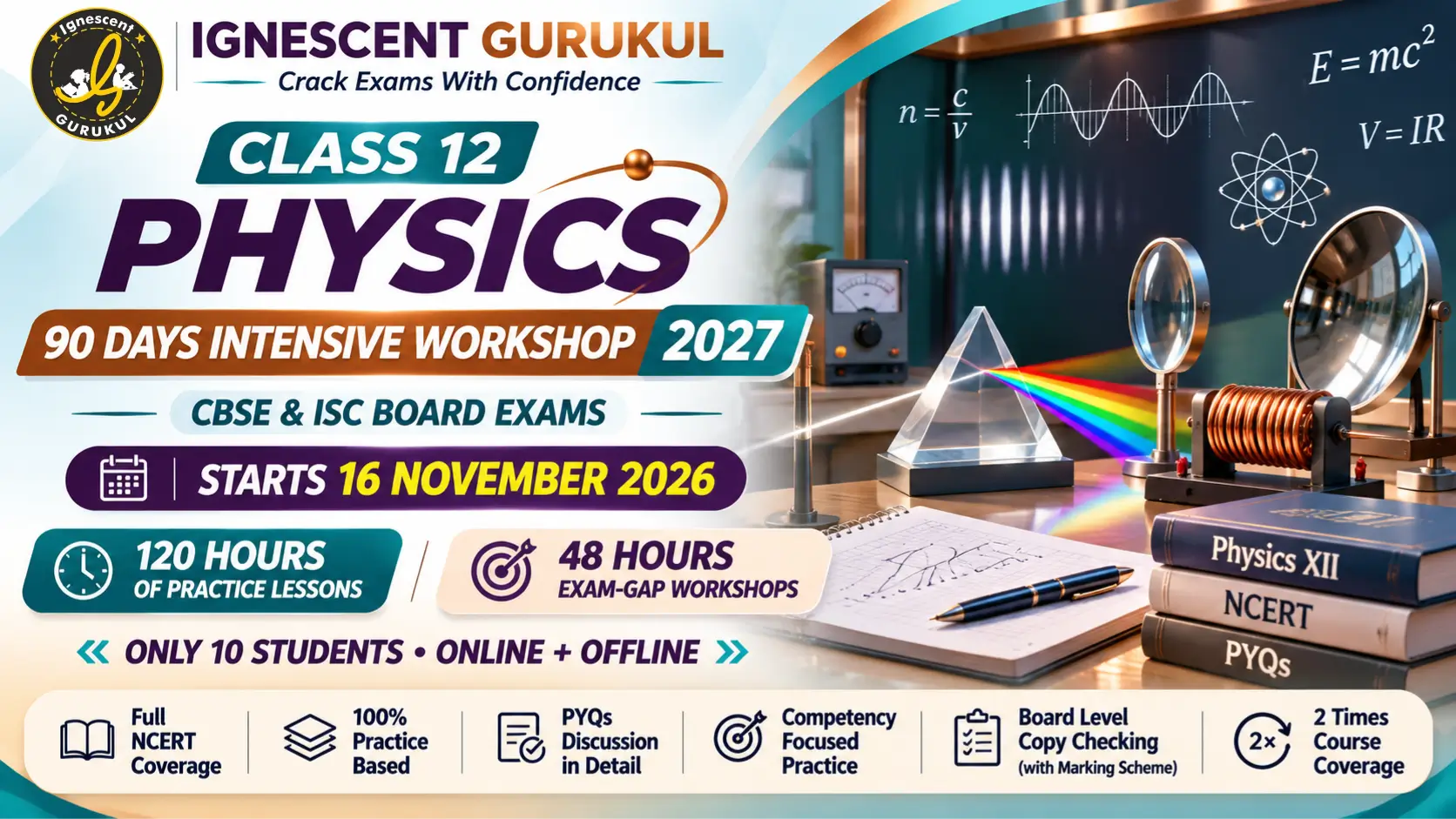
Class 12 Physics 90 Days Workshop 2027 — Ultimate Physics Crash Course for CBSE & ISC
A 100% practice-based Class 12 Physics crash course combining full NCERT coverage, 60 daily concept papers, guided derivations and numericals, board marking-scheme copy checking, 18 full-syllabus mock tests and separate CBSE/ISC exam-gap revision. Learn in a maximum 10-student group—live online or offline in Kolkata.
Ignescent Gurukul · Crack Exams With Confidence · Teaching Physics Since 2006
TEST.
IMPROVE.
Build accuracy, confidence and speed before the Physics board paper
Our 90 Days Physics Workshop brings together NCERT problem practice, modern-physics concepts, derivations, numerical accuracy, competency-based cases and board-pattern testing in an interactive small-group environment.
Ask for your Class 12 Physics preparation plan
Choose your board and batch. Our academic team will discuss your current marks, weak chapters, test-only package and online/offline availability.
Class 12 Physics 2027 Crash Course: 120 practice hours + 48 exam-gap hours
This is a single-subject CBSE and ISC Class XII Physics workshop, not a general PCM package. The first 60 weekday lessons build solutions, written methods and confidence; the second syllabus pass and final exam-gap classes target speed, accuracy and board-specific answers.
16 Nov 2026 – 7 Feb 2027
60 Monday–Friday teaching days × 2 hours = 120 hours of Physics practice. Saturdays: TTT. Sundays: FST plus CT–FFT in separate assessment windows. The 12th Saturday is kept as a flexible capstone/correction day.
CBSE 8–15 Feb · ISC 2–7 Mar
CBSE: 8 days × 6 hours = 48 hours.
ISC: 6 days × 8 hours = 48 hours. Supervised revision, time-bound 70-mark writing, detailed solution discussion and feedback; the individual plan is adjusted if other board papers clash.
Class timings, daily routine and live-interaction rules
| Day | Day batch | Evening batch | What happens |
|---|---|---|---|
| Monday–Friday | 1:30–3:30 PM IST | 6:00–8:00 PM IST | Guided Physics practice, oral and written CBP/CBT, textbook problems, derivations and checking |
| Saturday | TTT slots announced individually | One Taught Topic Test on 11 scheduled Saturdays | |
| Sunday | Separate online/offline assessment windows | Full-syllabus mock (FST) and chapter-wise full-format (CT–FFT); independent timings to avoid overlap | |
| Exam gap | Individual CBSE / ISC daily plan | 6–12-hour supervised revision format; credited Physics hours are 48 per applicable board plan | |
What exactly is included in the Physics Workshop fee?
Every written paper becomes a feedback instrument: attempt → check → understand the marking loss → correct → retest. Full NCERT Class 12 Physics Parts I and II, competency-focused questions, board-prescribed extensions for ISC and suitable PYQs are discussed with particular attention to the 2027 paper formats.
14-chapter syllabus checklist in the prescribed teaching sequence
Following the sequence you requested, Optics and Modern Physics come first, then electrostatics, electricity and magnetism. “Dual Nature of Particles” and “Dual Nature of Radiation and Matter” refer to the same official chapter and are covered once, thoroughly. We also treat Moving Charges and Magnetism and Magnetism and Matter as distinct chapters, so none of the official 14 CBSE chapters is missed.
| # | Physics chapter | In-practice focus | First pass |
|---|---|---|---|
| 01 | Ray Optics and Optical Instruments | Reflection/refraction, mirrors, lenses, lens-makers’ formula, prisms, optical instruments and full ray diagrams. | Weeks 1–2 |
| 02 | Wave Optics | Huygens principle, interference, YDSE, fringe width, diffraction and board-prescribed derivations. | Week 3 |
| 03 | Dual Nature of Radiation and Matter | Photoelectric effect, Einstein equation, stopping potential, photon energy, de Broglie wavelength. | Week 4 |
| 04 | Atoms | Rutherford model, Bohr model, electron transitions and atomic spectra. | Week 4 |
| 05 | Nuclei | Mass defect, binding energy, isotopes and nuclear energy. | Week 5 |
| 06 | Semiconductor Electronics | Energy bands, intrinsic/extrinsic semiconductors, p–n junction, diode and rectifier. | Week 5 |
| 07 | Electric Charges and Fields | Electrostatic force, field, flux, Gauss law, dipoles and applications. | Week 6 |
| 08 | Electrostatic Potential and Capacitance | Electric potential, equipotentials, dielectric, capacitors and stored energy. | Week 7 |
| 09 | Current Electricity | Drift, Ohm law, resistivity, Kirchhoff, cells, Wheatstone; ISC add-ons where prescribed. | Week 8 |
| 10 | Moving Charges and Magnetism | Biot–Savart/Ampère, magnetic force, loops, torque, galvanometer and conversions. | Week 9 |
| 11 | Magnetism and Matter | Magnetic properties, field lines, bar magnets and materials. | Week 10 |
| 12 | Electromagnetic Induction | Faraday, Lenz, inductance and flux-change problems. | Week 10 |
| 13 | Alternating Current | Peak/RMS, reactance, LCR circuit, phasors, power factor, generators and transformers. | Week 11 |
| 14 | Electromagnetic Waves | Displacement current, wave properties, spectrum and practical applications. | Week 11 |
Complete 60-day date-wise Physics teaching and practice planner
Exactly 60 working weekdays, 2 hours each = 120 dedicated teaching hours. Open any week to see the date, chapter, concept practice, PYQ/CBP or copy-checking focus. Each weekday carries one Concept Based Paper (CBP) for a total of 60.
Week 01 · 16–20 Nov 2026 · Ray Optics & Optical Instruments — I
Primary workshop objective: Ray Optics & Optical Instruments — I. Every lesson includes active solving, oral checks and one written CBP.
| Date | Session focus | Assessment |
|---|---|---|
| 16 Nov | Reflection, spherical mirrors, sign conventions and mirror formula | CBP 01 + oral CBT |
| 17 Nov | Refraction, Snell’s law, critical angle and total internal reflection | CBP 02 + oral CBT |
| 18 Nov | Spherical refraction, lenses and lens-maker’s formula | CBP 03 + oral CBT |
| 19 Nov | Combination of lenses, optical power, magnification and ray diagrams | CBP 04 + oral CBT |
| 20 Nov | NCERT/exemplar optics numericals, graph-based competency questions | CBP 05 + oral CBT |
Week 02 · 23–27 Nov 2026 · Ray Optics & Optical Instruments — II
Primary workshop objective: Ray Optics & Optical Instruments — II. Every lesson includes active solving, oral checks and one written CBP.
| Date | Session focus | Assessment |
|---|---|---|
| 23 Nov | Prism refraction, deviation, minimum deviation, dispersion | CBP 06 + oral CBT |
| 24 Nov | Microscope, telescope, angular magnification and diagrams | CBP 07 + oral CBT |
| 25 Nov | Mixed numerical cases: mirrors, lenses, prisms, optical instruments | CBP 08 + oral CBT |
| 26 Nov | PYQ-based derivations and stepwise mark-scheme writing | CBP 09 + oral CBT |
| 27 Nov | Ray Optics full-chapter copy-writing simulation and error correction | CBP 10 + oral CBT |
Week 03 · 30 Nov–4 Dec 2026 · Wave Optics
Primary workshop objective: Wave Optics. Every lesson includes active solving, oral checks and one written CBP.
| Date | Session focus | Assessment |
|---|---|---|
| 30 Nov | Wavefronts, Huygens principle, reflection and refraction | CBP 11 + oral CBT |
| 1 Dec | Interference, coherent sources, path difference, YDSE | CBP 12 + oral CBT |
| 2 Dec | Fringe width, intensity ideas and conceptual numericals | CBP 13 + oral CBT |
| 3 Dec | Diffraction/other board-prescribed topics; diagrams and conditions | CBP 14 + oral CBT |
| 4 Dec | Ray + Wave Optics mixed competency drills and PYQ solutions | CBP 15 + oral CBT |
Week 04 · 7–11 Dec 2026 · Dual Nature + Atoms
Primary workshop objective: Dual Nature + Atoms. Every lesson includes active solving, oral checks and one written CBP.
| Date | Session focus | Assessment |
|---|---|---|
| 7 Dec | Photoelectric effect, laws, stopping potential and Einstein equation | CBP 16 + oral CBT |
| 8 Dec | Photons, work function, graphs, threshold frequency, numericals | CBP 17 + oral CBT |
| 9 Dec | Matter waves, de Broglie relation, mixed photon/electron PYQs | CBP 18 + oral CBT |
| 10 Dec | Atomic models, Rutherford scattering and Bohr postulates | CBP 19 + oral CBT |
| 11 Dec | Hydrogen spectra, energy transitions, radius and energy numericals | CBP 20 + oral CBT |
Week 05 · 14–18 Dec 2026 · Nuclei + Semiconductor Electronics
Primary workshop objective: Nuclei + Semiconductor Electronics. Every lesson includes active solving, oral checks and one written CBP.
| Date | Session focus | Assessment |
|---|---|---|
| 14 Dec | Nuclear composition, isotopes, radius and density | CBP 21 + oral CBT |
| 15 Dec | Mass defect, binding energy, nuclear reactions and energy | CBP 22 + oral CBT |
| 16 Dec | Semiconductor bands, conductors/insulators, intrinsic/extrinsic | CBP 23 + oral CBT |
| 17 Dec | p–n junction diode, biasing, V–I characteristics | CBP 24 + oral CBT |
| 18 Dec | Diode as rectifier, board diagrams, modern-physics synthesis | CBP 25 + oral CBT |
Week 06 · 21–25 Dec 2026 · Electric Charges and Fields
Primary workshop objective: Electric Charges and Fields. Every lesson includes active solving, oral checks and one written CBP.
| Date | Session focus | Assessment |
|---|---|---|
| 21 Dec | Coulomb’s law, superposition and charge distributions | CBP 26 + oral CBT |
| 22 Dec | Electric field and field lines, electric dipoles and dipole moment | CBP 27 + oral CBT |
| 23 Dec | Electric field due to charges/dipoles, torque and energy | CBP 28 + oral CBT |
| 24 Dec | Flux, Gauss theorem and standard Gaussian applications | CBP 29 + oral CBT |
| 25 Dec | Electrostatics graph/diagram/PYQ drills; holiday adjustments if needed | CBP 30 + oral CBT |
Week 07 · 28 Dec 2026–1 Jan 2027 · Electrostatic Potential and Capacitance
Primary workshop objective: Electrostatic Potential and Capacitance. Every lesson includes active solving, oral checks and one written CBP.
| Date | Session focus | Assessment |
|---|---|---|
| 28 Dec | Potential and potential difference, point charges and dipoles | CBP 31 + oral CBT |
| 29 Dec | Equipotentials, potential energy, conductors and dielectrics | CBP 32 + oral CBT |
| 30 Dec | Capacitance, parallel-plate capacitor and dielectric insertion | CBP 33 + oral CBT |
| 31 Dec | Series/parallel capacitors, energy and multi-step numericals | CBP 34 + oral CBT |
| 1 Jan | Electrostatics cumulative worksheet and board answer practice | CBP 35 + oral CBT |
Week 08 · 4–8 Jan 2027 · Current Electricity
Primary workshop objective: Current Electricity. Every lesson includes active solving, oral checks and one written CBP.
| Date | Session focus | Assessment |
|---|---|---|
| 4 Jan | Current, drift speed, mobility, Ohm’s law and V–I curves | CBP 36 + oral CBT |
| 5 Jan | Resistivity, temperature dependence, power and circuits | CBP 37 + oral CBT |
| 6 Jan | EMF/internal resistance and combinations of cells | CBP 38 + oral CBT |
| 7 Jan | Kirchhoff laws, Wheatstone bridge, circuit numericals | CBP 39 + oral CBT |
| 8 Jan | ISC-specific potentiometer applications where prescribed; PYQs | CBP 40 + oral CBT |
Week 09 · 11–15 Jan 2027 · Moving Charges & Magnetism
Primary workshop objective: Moving Charges & Magnetism. Every lesson includes active solving, oral checks and one written CBP.
| Date | Session focus | Assessment |
|---|---|---|
| 11 Jan | Magnetic field, Biot–Savart law and circular current loop | CBP 41 + oral CBT |
| 12 Jan | Ampère law, straight wire and solenoid | CBP 42 + oral CBT |
| 13 Jan | Lorentz force, motion of charged particles in fields | CBP 43 + oral CBT |
| 14 Jan | Forces between current wires, loops, magnetic dipoles and torque | CBP 44 + oral CBT |
| 15 Jan | Moving-coil galvanometer, ammeter/voltmeter conversion, PYQs | CBP 45 + oral CBT |
Week 10 · 18–22 Jan 2027 · Magnetism & Matter + Electromagnetic Induction
Primary workshop objective: Magnetism & Matter + Electromagnetic Induction. Every lesson includes active solving, oral checks and one written CBP.
| Date | Session focus | Assessment |
|---|---|---|
| 18 Jan | Magnetic dipole, bar magnet and field-line patterns | CBP 46 + oral CBT |
| 19 Jan | Dia-, para- and ferromagnetism; magnetic properties | CBP 47 + oral CBT |
| 20 Jan | Magnetic flux, Faraday law, induced EMF | CBP 48 + oral CBT |
| 21 Jan | Lenz law, energy conservation and induced-current reasoning | CBP 49 + oral CBT |
| 22 Jan | Self and mutual inductance; mixed board-case practice | CBP 50 + oral CBT |
Week 11 · 25–29 Jan 2027 · Alternating Current + Electromagnetic Waves
Primary workshop objective: Alternating Current + Electromagnetic Waves. Every lesson includes active solving, oral checks and one written CBP.
| Date | Session focus | Assessment |
|---|---|---|
| 25 Jan | Sinusoidal AC, peak/RMS and phase relations | CBP 51 + oral CBT |
| 26 Jan | Reactance, impedance, LCR circuits, resonance | CBP 52 + oral CBT |
| 27 Jan | Power factor, transformers and AC generators | CBP 53 + oral CBT |
| 28 Jan | AC and EMI derivation/numerical PYQ drills | CBP 54 + oral CBT |
| 29 Jan | Displacement current, EM waves, spectra and applications | CBP 55 + oral CBT |
Week 12 · 1–5 Feb 2027 · Second full-syllabus pass + written mock corrections
Primary workshop objective: Second full-syllabus pass + written mock corrections. Every lesson includes active solving, oral checks and one written CBP.
| Date | Session focus | Assessment |
|---|---|---|
| 1 Feb | Pass 2: Optics and Modern Physics rapid review | CBP 56 + oral CBT |
| 2 Feb | Pass 2: Electrostatics and Current Electricity | CBP 57 + oral CBT |
| 3 Feb | Pass 2: Magnetism, EMI, AC and electromagnetic waves | CBP 58 + oral CBT |
| 4 Feb | CBSE/ISC separate 70-mark writing simulation, diagrams and derivations | CBP 59 + oral CBT |
| 5 Feb | Final error log, NCERT back questions, marking-scheme correction | CBP 60 + oral CBT |
Second coverage begins before the final gap
In Week 12 we review every major Physics block again through mixed papers, formula and derivation checks, compulsory diagrams, numerical solution steps and personalised error logs. In the 48-hour exam-gap window, those same blocks are recalled under final-paper timings and corrected using each board’s current marking scheme.
14 CT–FFT + 18 FST + 11 TTT: dates and how they fit
Below is a proposed institute test timetable that reconciles all your announced quantities without double counting. Sunday has a Full Syllabus Mock Test (FST) and a Chapter Test–Full Format Test (CT–FFT) in separate assessment windows. The first FSTs act as diagnostic/progressive full-syllabus papers, even before workshop teaching has reached all chapters.
| Test format | Allocated dates | Total |
|---|---|---|
| TTT · taught-topic Saturday test | 11 consecutive Saturdays, 21 Nov 2026–30 Jan 2027 | 11 |
| FST · full-syllabus board mock | 12 Sundays, 22 Nov 2026–7 Feb 2027; plus 8–13 Feb 2027 (6 additional mocks) | 18 |
| CT–FFT · chapter-wise full-format test | 12 Sundays, 22 Nov 2026–7 Feb 2027; plus 10 and 12 Feb 2027 (2 additional tests) | 14 |
Weekly Saturday/Sunday assessment calendar
| Week | Saturday | Sunday — CT–FFT + FST |
|---|---|---|
| 1 | TTT 01 · Sat 21 Nov 2026 | CT–FFT 01 + FST 01 · Sun 22 Nov 2026 |
| 2 | TTT 02 · Sat 28 Nov 2026 | CT–FFT 02 + FST 02 · Sun 29 Nov 2026 |
| 3 | TTT 03 · Sat 5 Dec 2026 | CT–FFT 03 + FST 03 · Sun 6 Dec 2026 |
| 4 | TTT 04 · Sat 12 Dec 2026 | CT–FFT 04 + FST 04 · Sun 13 Dec 2026 |
| 5 | TTT 05 · Sat 19 Dec 2026 | CT–FFT 05 + FST 05 · Sun 20 Dec 2026 |
| 6 | TTT 06 · Sat 26 Dec 2026 | CT–FFT 06 + FST 06 · Sun 27 Dec 2026 |
| 7 | TTT 07 · Sat 2 Jan 2027 | CT–FFT 07 + FST 07 · Sun 3 Jan 2027 |
| 8 | TTT 08 · Sat 9 Jan 2027 | CT–FFT 08 + FST 08 · Sun 10 Jan 2027 |
| 9 | TTT 09 · Sat 16 Jan 2027 | CT–FFT 09 + FST 09 · Sun 17 Jan 2027 |
| 10 | TTT 10 · Sat 23 Jan 2027 | CT–FFT 10 + FST 10 · Sun 24 Jan 2027 |
| 11 | TTT 11 · Sat 30 Jan 2027 | CT–FFT 11 + FST 11 · Sun 31 Jan 2027 |
| 12 | Capstone corrections · Sat 6 Feb 2027 (not counted as TTT) | CT–FFT 12 + FST 12 · Sun 7 Feb 2027 |
Additional exam-gap tests
| Date | Extra test | Expected analysis |
|---|---|---|
| Mon 8 Feb 2027 | FST 13 | Board mark-scheme corrections and redraft of weak answers |
| Tue 9 Feb 2027 | FST 14 | Board mark-scheme corrections and redraft of weak answers |
| Wed 10 Feb 2027 | FST 15 + CT–FFT 13 | Board mark-scheme corrections and redraft of weak answers |
| Thu 11 Feb 2027 | FST 16 | Board mark-scheme corrections and redraft of weak answers |
| Fri 12 Feb 2027 | FST 17 + CT–FFT 14 | Board mark-scheme corrections and redraft of weak answers |
| Sat 13 Feb 2027 | FST 18 | Board mark-scheme corrections and redraft of weak answers |
Scheduling safeguard: On Sundays and on 10/12 February, two tests appear on the same date. Their start times and whether a student uses supervised offline, online timed, or makeup windows must be confirmed at admission so the workload remains feasible. If an official school/practical exam clashes, the institute will assign a different test window. ISC students may complete a board-specific mock allocation closer to 8 March rather than be forced to follow a CBSE-only test deadline.
14 dedicated chapter worksheets
Each of the 14 syllabus chapters above gets one dedicated worksheet. Worksheets are issued on completing the chapter and contain NCERT exercises, competency questions, numerical applications, reasoning, marking-scheme derivations and a corrective answer key/discussion. These 14 worksheets are distinct from the 60 daily CBP.
CBSE vs ISC Class 12 Physics 2027 exam pattern and marks
CBSE Physics · subject 042
Official Class XII 2026–27 sample: 70 marks, 3 hours, 33 questions. Sections A–E have the following structure:
| Section | Questions | Marks |
|---|---|---|
| A | 12 MCQ + 4 assertion/reason | 16 × 1 = 16 |
| B | 5 very short answers | 5 × 2 = 10 |
| C | 7 short answers | 7 × 3 = 21 |
| D | 2 case-study questions | 2 × 4 = 8 |
| E | 3 long answers | 3 × 5 = 15 |
| Total | 33 questions | 70 |
Official sample notes internal choices in selected questions and no calculators. The 2026–27 curriculum also specifies separate practical assessment.
ISC Physics · subject 861
Official 2027 syllabus: Paper I Theory (70 marks, 3 hours); Paper II Practical (15 marks, 3 hours); Project Work (10 marks); Practical File (5 marks).
ISC teaching and copy-checking will include the council-prescribed chapter details, numerical proof steps, graphs/diagrams, appropriate derivations, and potential syllabus differences including potentiometer applications.
The ISC 2027 Physics examination is on Monday, 8 March 2027 at 2:00 PM IST according to the supplied CISCE date sheet; a separate 15-minute reading period applies.
CBSE officially published theory weightage
| CBSE Physics 2026–27 unit group | Marks out of 70 |
|---|---|
| Electrostatics + Current Electricity | 16 |
| Magnetic Effects + Electromagnetic Induction / Alternating Current | 17 |
| Electromagnetic Waves + Optics | 18 |
| Dual Nature + Atoms & Nuclei | 12 |
| Electronic Devices | 7 |
| Total | 70 |
These are official group-wise marks from the CBSE 2026–27 curriculum, not invented per-chapter marks predictions. Likewise, ISC publishes subject-unit weights which must be interpreted as grouped where cells are merged, not simply added row-by-row.
Phase 2 (CBSE): 8–15 February 2027 · 48-hour daily exam-gap workshop
CBSE Physics board examination: Tuesday, 16 February 2027, 10:30 AM–1:30 PM IST according to your uploaded CBSE date sheet (issued 6 November 2026). The following is the institute’s proposed 6 hours/day supervised plan, not a CBSE-issued schedule.
| Date | 6-hour Physics revision block | Daily check |
|---|---|---|
| 8 Feb 2027 | Optics: complete diagram/derivation review and 70-mark FST 13 | Marking-scheme errors and ray sketches |
| 9 Feb 2027 | Modern Physics: dual nature, atoms, nuclei, semiconductor devices; FST 14 | Formula and explanation quality |
| 10 Feb 2027 | Electrostatics + capacitor circuits; FST 15 + CT–FFT 13 | Numerical steps and written diagram checks |
| 11 Feb 2027 | Current Electricity + magnetism; FST 16 | Graph interpretation and circuit accuracy |
| 12 Feb 2027 | EMI, AC, EM waves; FST 17 + CT–FFT 14 | Sign conventions, derivation continuity |
| 13 Feb 2027 | Complete 70-mark paper simulation; FST 18 | Full copy checking against CBSE scheme |
| 14 Feb 2027 | Weakest five error types; NCERT exercises/competency cases | Redraft inaccurate answers; lighter recovery |
| 15 Feb 2027 | High-confidence recall: constants, derivations, diagrams, time plan | Short oral + written recall; rest and exam readiness |
Working model per day: 90 minutes concept recall; 120 minutes paper practice; 90 minutes paper discussion/copy checking; 60 minutes personal doubt and error removal. Some full-paper mocks run as a single 3-hour block with other tasks rearranged; no attempt to fit two 3-hour formal tests into the same short session without scheduling them separately.
On 16 February do not schedule workshop classes during the official examination. Students should follow the admit card and their school instructions for reporting time.
ISC Physics Exam Gap Workshop: 2–7 March 2027 · 48 dedicated hours
ISC Physics board exam: Monday, 8 March 2027, 2:00 PM IST (reading from 1:45 PM under the CISCE date sheet). Many ISC students also have Mathematics on 1 March, so the intensive Physics mock block follows that paper. The March plan is the ISC learner’s 48 credited exam-gap hours, not an additional automatic 48h on top of the course inclusion.
| Date | ISC-specific supervised practice | Hours |
|---|---|---|
| 2 Mar 2027 | Optics + dual nature; derivations, apparatus diagrams and 70-mark board pattern | 8 |
| 3 Mar 2027 | Atoms, nuclei, semiconductor devices; quick numericals + detailed ISC copy checking | 8 |
| 4 Mar 2027 | Electrostatics + current electricity including ISC-prescribed extensions | 8 |
| 5 Mar 2027 | Magnetism, magnetic matter, EMI and AC; diagram and graph correction | 8 |
| 6 Mar 2027 | Complete timed ISC Physics theory mock + systematic paper-by-paper corrections | 8 |
| 7 Mar 2027 | Weak-topic retest, formula/derivation recall, final checklist and lighter revision | 8 |
Any student with a clashing ISC subject (e.g. Physical Education on 3 March) receives an individually adjusted session/makeup. The earlier 8–15 February CBSE-oriented gap week is not automatically the ISC final revision week; ISC students can receive interim support and then their main board-specific March workshop.
Ignescent Gurukul’s 100% practice-based Physics method
01 · See and explain
One problem is solved, then students explain the laws, diagram, assumptions and units orally with mic/camera on during online classes. Errors are caught immediately.
02 · Write and verify
Students complete a written concept test, derivation, ray/circuit diagram or competency case. Teachers check meaningful steps, not only the final answer.
03 · Board marking scheme
CBSE 2027 and ISC 2027 samples and official scheme rules guide evaluations. Marks can be lost through incorrect diagrams, unsupported formulae, missing units or weak explanations.
04 · Repair and reattempt
After FST/CT–FFT, students get an error log and a targeted worksheet/retest. Each paper should improve the next, not just produce another score.
Exams are scored on answers, not on remembered lectures
We practise NCERT solved examples and end exercises, prescribed board items, competency-focused cases, assertion–reason statements, graphs, numerical questions, ray diagrams and derivation writing. Previous-year papers are discussed in depth to identify recurring concepts without promising any “sure-shot” questions.
Class 12 Physics 90 Days Workshop 2027 fees
For the announced Physics-only workshop: 120 hours of dedicated teaching, 48 hours of exam-gap support, CBP, chapter tests, FST, worksheets and copy checking. Confirm learning mode and time slot before paying.
Enquire for admission →Request the subject-specific test-only offer including mock formats, board version, number of permitted attempts, copy checking and access duration. No fee has been assumed.
Contact for test fees →Class 12 Physics Crash Course 2027 — frequently asked questions
Open a question to view the answer without leaving this page.
When does the Class 12 Physics 90 Days Workshop 2027 begin?
What are the day and evening batch timings?
Is this Physics course for CBSE or ISC?
Are classes offline or online?
Must I keep my microphone and camera on online?
How many students are in a group?
What does the ₹21,000 workshop fee include?
Can I buy only Physics mock tests?
What is a CBP?
What is a CBT?
What is a CT–FFT?
What is an FST?
What is a TTT?
Will there be tests on Sundays?
How can I attend two tests on the same Sunday?
How many chapter-wise worksheets are included?
Is the full NCERT Class 12 Physics syllabus taught?
Is Dual Nature of Particles a separate chapter from Dual Nature of Radiation and Matter?
Do you cover Magnetism and Matter separately?
Are competency-focused questions included?
Will you teach numericals and derivations?
Are previous-year questions (PYQs) discussed?
Is there handwritten answer-booklet copy checking?
What is the CBSE Class 12 Physics exam date in 2027?
When is the ISC Class 12 Physics paper in 2027?
What are the CBSE 2027 Physics theory marks and question types?
Does ISC Physics also have 70 theory marks?
Why is the ISC revision plan in March?
Are the 48 exam-gap hours additional for ISC after the CBSE gap?
Can the timetable be adjusted around practicals and other school exams?
What if I join late?
Can I study in Kolkata?
Is the workshop suitable for a weak student?
Are CBSE and ISC copy-checking rules identical?
How can I enrol in the Physics course?
Does the workshop guarantee 95% or a particular score?
Follow Ignescent Gurukul for Physics lessons and course updates
Ignescent Gurukul is an independent educational provider. CBSE and ISC are external examination boards; board links above are references, not an affiliation or endorsement. Details and seat availability are confirmed by admissions.